 Cartagena City Guide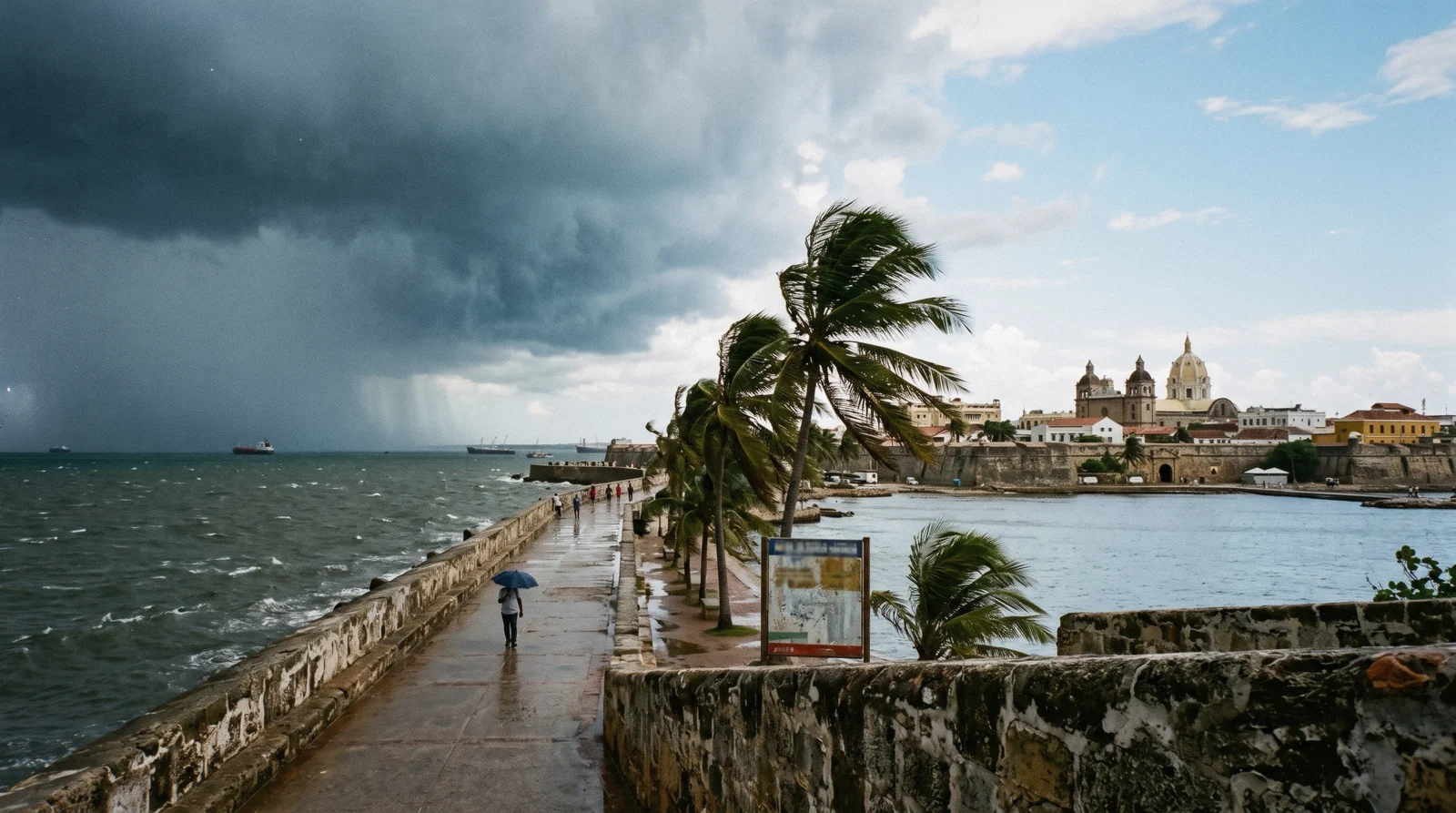
Best Time to Visit Cartagena
The best time to visit Cartagena is set by two things that move independently: the rain and the wind. The month-by-month figures below come from the Open-Meteo ERA5 reanalysis computed for Cartagena's coordinates over the thirty years from 1995 to 2024, because no month-by-month table could be sourced from IDEAM, Colombia's official weather agency, directly. Cartagena's own annual averages, relayed from IDEAM through Colombian press, agree with the pattern here, October wettest and February driest, even though the two sources' totals differ, which is stated honestly rather than smoothed into one number. Once the weather question is answered, the sights and prices themselves are on the Cartagena city guide.
Quick answer Driest months, wettest month, and the wind that hits the boat day
The best time to visit Cartagena is January through March, the driest stretch of the year on thirty years of data, with average highs near 31°C and only a handful of rainy days a month. October is the wettest month by a wide margin, averaging rain on roughly 28 of its 31 days, and September and November are not far behind, which makes the Rosario Islands boat day a genuine gamble in that window. Trade winds blow hardest from December through April, peaking in January and February, adding chop to the same island crossing even on a dry day. Temperatures barely move across the year, so the real choice is between rain and wind, not between hot and cool.
Key takeaways
- The driest, calmest months are January to March, the safest bet for the island boat day.
- October is the wettest month of the year on thirty years of ERA5 data, rain on about 28 days out of 31, see the weather table.
- Trade winds peak January and February, which adds chop to the Rosario Islands crossing even without rain.
- Two dates move hotel prices hard: the 11 November independence fiestas and Hay Festival, 28-31 January 2027.
Cartagena month by month
Average daily high temperature by month in Celsius, with the Fahrenheit reading underneath, computed from the Open-Meteo ERA5 reanalysis for 10.42 N, 75.55 W over the thirty years from 1995 to 2024.
Temperatures barely move across the year, average highs sit within three degrees of each other every month, so heat is not the variable that should choose your dates. Rain and wind are. October is the wettest month at roughly 256 mm on the ERA5 reading, and January to March is the driest three-month stretch, under 20 mm each.
Cartagena weather by month
Thirty-year averages from the Open-Meteo ERA5 archive for Cartagena's coordinates, 1 January 1995 to 31 December 2024, monthly rainfall, the trade-wind season, sea state for the island crossing and what is on the calendar that month.
| Month | Rain | Trade winds | Island crossing | What's on |
|---|---|---|---|---|
| January | 9 mm, driest quarter begins | Building, strong by late month | Choppy on windy days, dry underfoot | New Year crowds ease by mid-month |
| February | 7 mm, the driest month | Peak trade winds, 20+ knots common | Wind chop is the main risk, not rain | Quiet month, low hotel demand |
| March | 18 mm, still dry | Peak trade winds continue | Still choppy but rain is not a factor | Shoulder month, prices moderate |
| April | 72 mm, rain returns | Winds ease through the month | Calmer seas, first real rain risk | Easter/Semana Santa falls in this window most years |
| May | 167 mm, wet season begins | Light | Afternoon downpours possible, mornings often clear | Low season, fewer cruise-ship days |
| June | 172 mm | Light | Short tropical storms, not all-day rain | Domestic school-holiday bump |
| July | 156 mm | Light | Similar to June, brief afternoon storms | Domestic holiday season continues |
| August | 181 mm | Light | Wet but not the year's worst | Hurricane-season watch begins for the region |
| September | 191 mm | Light | Rain most days, plan indoor backups | Quietest tourist month of the year |
| October | 256 mm, the wettest month | Light | The least reliable month for a boat day | Lowest hotel demand of the year |
| November | 204 mm, still very wet | Light, building toward December | Improving late in the month | Independence fiestas around 11 November, preludes from late October |
| December | 60 mm, rain drops fast | Building toward January's peak | Improving through the month | Holiday season, prices climb through the month |
IDEAM's own press-relayed annual summary gives Cartagena roughly 1,020 mm of rain a year against the ERA5 reading's higher total for the same span. The two use different methodology and periods, but they agree on the pattern that matters for planning, October wettest, February driest. Rain figures here are the ERA5 monthly means, not the wetter IDEAM annual total.
Two different problems: rain, and trade-wind chop
Cartagena's calendar has two variables that move on opposite schedules, and mixing them up is the most common planning mistake. Rain follows the wet season, building from April, peaking around October at roughly 256 mm on the ERA5 reading, and dropping off fast through November and December. Trade winds run the other way: light for most of the wet season, then building from December and peaking in January and February, the driest months of the year. A traveller who books February for the dry weather and then finds the Rosario Islands crossing choppier than expected has run into the wind, not the rain.
Neither figure is officially confirmed at the knot level for this stretch of coast. The trade-wind pattern described here comes from tour-operator and kitesurf-site reporting rather than an official DIMAR or IDEAM bulletin, so it is printed as a seasonal pattern, not a guaranteed forecast for any single day. What is worth planning around either way: a January or February island day should expect chop even under a clear sky, and a September or October island day should expect the tour to be rescheduled or cancelled more often than in the dry months. The island day cost breakdown covers what happens to your money when a boat day is cancelled.
January to March: the driest stretch, and why it still isn't cool
The three driest months on the ERA5 reading average under 20 mm of rain each, February the lowest at roughly 7 mm, which matches the pattern IDEAM's own annual summary describes, February as the driest month of the year. Average highs sit around 31°C in all three months, so 'dry season' in Cartagena means dry, not cool: humidity stays high and the ramparts and plazas offer little shade at midday.
This is the safest window for the Rosario Islands boat day on rain alone, though the trade winds peaking in these same months mean a choppier ride than in the calmer wet-season months. It is also the window that includes two demand spikes: the tail of the December-January holiday season and Hay Festival, whose next edition runs 28 to 31 January 2027. Outside those specific dates, January to March is a comparatively quiet stretch for hotel demand, since Cartagena has no official month-by-month visitor count published to compare against.
May to November: rain climbs, then peaks hard in October
Rain returns in April, roughly 72 mm on the ERA5 reading, and builds through the wet season to a peak of about 256 mm in October before dropping sharply in December. September, October and November are the three wettest months, all averaging rain on more than 20 of their days by the same measure, though a Cartagena wet-season day is rarely a washout: the pattern is short, heavy tropical downpours rather than grey all-day rain, closer to what the Florence-style European wet season is not.
The practical effect is on the island day and the outdoor walking plan, not on indoor sightseeing. The fort, the museums and the churches inside the walled city are unaffected by an afternoon downpour, and the walled-city walk itself is short enough to dodge one shower. A Rosario Islands day booked for September through November should have a backup plan, since operators reschedule or cancel more often in this window than in the dry months, a pattern reported by operators rather than published as an official cancellation rate.
Hurricane season: the risk is indirect, not a direct hit
The Atlantic hurricane season runs officially from 1 June to 30 November, with the highest-risk window for this stretch of coast falling in August through October. Cartagena is not usually in a hurricane's direct path, but a storm passing well offshore can still push swell into the bay, delay boats and trigger navigation restrictions on the islands crossing. Hurricane Melissa in 2025, a Category 5 storm, generated roughly two metres of swell in Cartagena's waters without making landfall anywhere near the city, which is the pattern to expect: indirect weather, not a direct strike.
Official forecasts for the 2026 season point to 8 to 14 tropical storms, 3 to 6 hurricanes and 1 to 3 major hurricanes across the wider Atlantic basin. None of that is a Cartagena-specific number, and no official source publishes a city-level hurricane-impact forecast, so treat the season as a reason to check a live marine forecast before an August-to-October boat day, not as a reason to avoid the city outright.
The two dates that move hotel prices
Two fixed events reshape the calendar more than any weather pattern. The independence fiestas around 11 November run from preludes in October through a full schedule in mid-November: a bathing-suit parade on 6 November in Plaza de la Aduana, the formal session and floral offering on 11 November itself, concerts on 13 and 14 November, and the popular parade and Getsemaní cabildo on 15 November, with performers including Juan Luis Guerra, Grupo Niche and Silvestre Dangond confirmed for the 2026 edition. It is recognised as the city's Intangible Cultural Heritage and it fills the historic centre with parades and street parties for over a week. Rooms inside the wall sell out well ahead of the date and prices climb hard. This also falls inside the wettest stretch of the year on the ERA5 reading, so a traveller coming for the festival should expect both rain and crowds.
Hay Festival Cartagena, the city's international literature and arts festival, has its next edition running 28 to 31 January 2027, with tickets going on sale the November before. It draws international writers and a dedicated crowd for a few days each January, and hotel demand in the historic centre rises accordingly, though it is a smaller, more contained spike than the November fiestas. Neither event has a confirmed effect from the facts pack on whether Semana Santa (Holy Week) changes bus or boat schedules in Cartagena specifically, so no claim is made about it here. Check closer to the date if your trip falls in that week.
Hay Festival dates: hayfestival.com/cartagena official site. Climate figures: Open-Meteo ERA5 archive.
Bookings that fit the season
One pick for the dry, windy months and one for the wet season, when an indoor booking is the safer hedge. Prices and ratings are the platform's own figures. Figures current in Q3 2026.
 from $72.90
Cartagena: 5-Stop Rosario Islands Tour, Lunch, & Beach Clubs
A 6.5-hour speedboat run to the Rosario Islands with two sightseeing stops, three island or beach club visits and lunch, plus an optional Oceanarium add-on. The Eco and VIP ticket tiers change which islands and boats you get, so the beach club shown in listing photos isn't guaranteed for every ticket type.
Check Availability from $57.93
Cartagena: Guided Street Food Tour with 10+ Tastings
A shared 2.5-hour tasting walk through the Walled City covering 9 to 10 Colombian street foods and drinks, ending near a specialty coffee stop. It's a shared departure with no stated group cap, so it can run larger than the small-group food tours here.
Check AvailabilityPrices, ratings and details are the platform's own. dollar figures are the listed prices — the platform bills in your account's currency.
Plan around the weather
What the island day actually costs
The boat fare, the dock charge and the park fee, and what happens when a wet-season sailing is cancelled: the Cartagena city guide.
The real total, line by lineHow many nights Cartagena needs
Two nights against five, mapped to what fits in each: the Cartagena city guide.
3 nights is the first-visit sweet spotWhere to stay
Six areas compared, so a rainy afternoon is a short walk from your room, not a taxi: Where to Stay.
6 areas comparedBest time to visit Cartagena: questions
What is the rainy season in Cartagena?
Roughly May through November, with September, October and November the three wettest months. October is the peak on thirty years of ERA5 data, averaging about 256 mm and rain on roughly 28 of its 31 days. The full month grid is in the weather table.
What is the cheapest month to visit Cartagena?
No official month-by-month hotel-price index exists for Cartagena, so no month is named as cheapest here. The wettest months, September and October, carry the lowest tourist demand on the ERA5 rain pattern and by general seasonal logic, and the weeks around 11 November and late January are the two confirmed demand spikes to avoid if budget matters. See the two dates that move hotel prices.
What is the driest month in Cartagena?
February, averaging about 7 mm on the ERA5 reading, which matches the pattern IDEAM's own annual summary describes. January and March are close behind, all three under 20 mm. See January to March.
Is November a good time to visit Cartagena?
It is one of the wettest months of the year, averaging around 204 mm, and it is also the month of the independence fiestas around 11 November, when the old town fills with parades and hotel prices climb. Good for the festival, a difficult month for weather. See the two dates that move hotel prices.
Is October a good time to visit Cartagena?
It is the wettest month of the year on thirty years of ERA5 data, averaging roughly 256 mm, and the least reliable month for the Rosario Islands boat day. It is also the quietest month for hotel demand. See May to November.
Does Cartagena get hurricanes?
Rarely a direct hit. The official Atlantic hurricane season runs 1 June to 30 November, highest risk August to October, and Cartagena typically sees indirect effects, swell and rain from storms passing offshore, rather than landfall. Hurricane Melissa in 2025 generated about two metres of swell without making landfall nearby. See hurricane season.
How windy does Cartagena get?
Trade winds peak in January and February, reported at 20 to 25 knots on average with gusts higher, mainly from tour-operator and kitesurf sources rather than an official bulletin. The wind mainly affects the Rosario Islands boat crossing, adding chop even on a dry day. See rain vs. wind.
Prices, hours and terms are set by the venue or operator and confirmed at checkout.
We may earn a commission if you book through one of our links, at no extra cost to you. Full affiliate disclosure