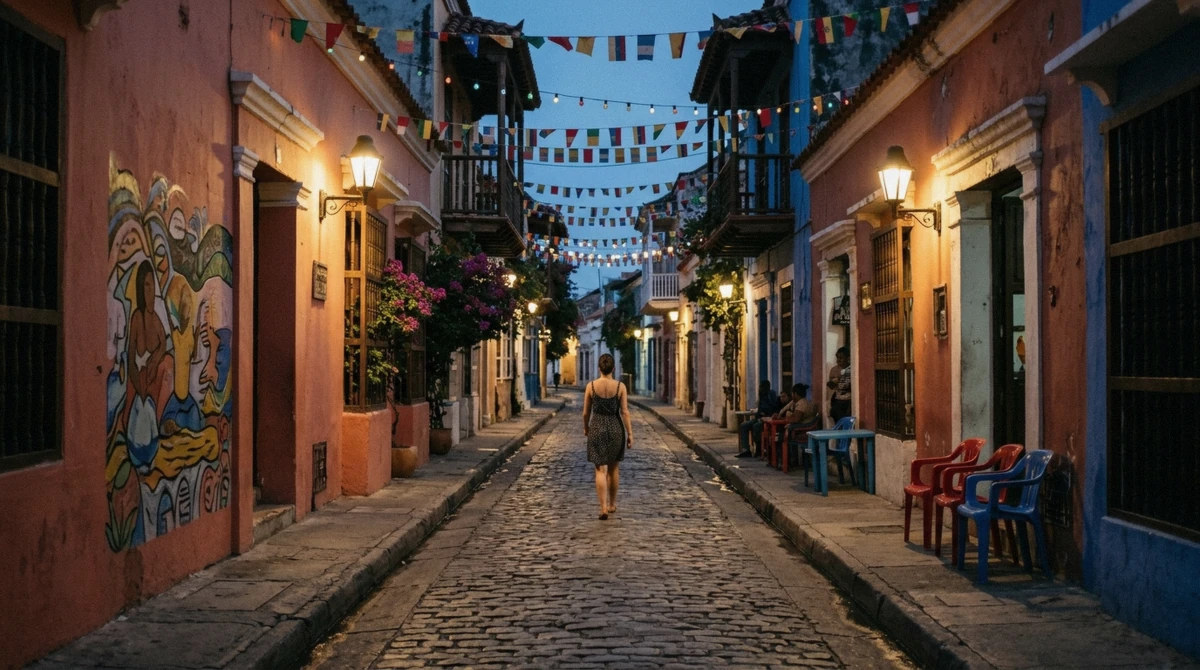
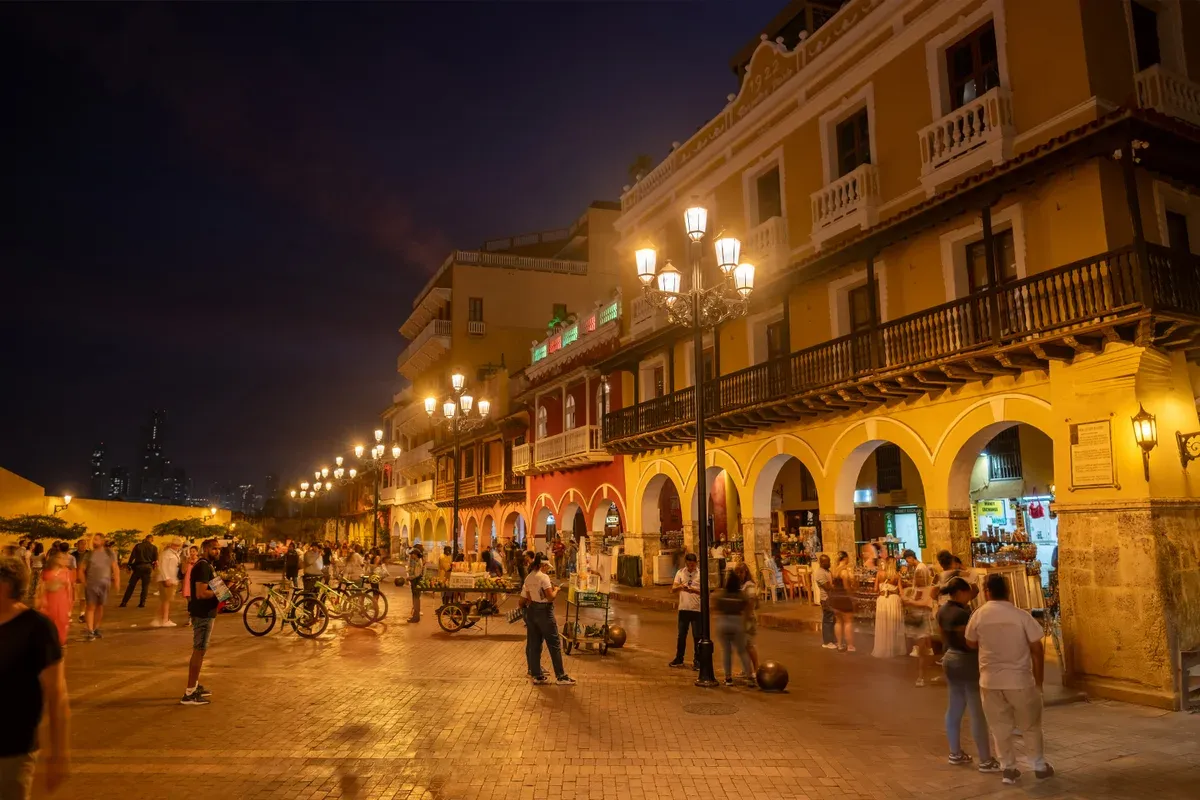
Balconies and lamplit walls of the old town at dusk on a Cartagena, Colombia city guide
Cartagena, Colombia: An Independent City Guide
The walled city costs nothing to walk. What costs money in Cartagena, Colombia is the fort on the hill, the churches that charge foreigners a separate rate, and the boat day out to the islands, where the fare you book is only the first of the charges you pay. This guide prints each one from the source that sets it.
Cartagena is good for tourists who want history, heat and Caribbean food in one walkable package, and it is best known for its walled old town and the fortress of San Felipe de Barajas. The fort is the only big-ticket item, at $12.06 (38,000 COP) for a foreign adult, while the walled city itself is free to enter. The Rosario Islands day is where budgets break, because the boat fare is only the first of several charges collected at the dock. Three nights suits most first visits. The city is a normal big Latin American city, which means petty scams rather than anything targeting tourists as a class.
Key takeaways
The fort ticket is $12.06 (38,000 COP) for a foreign adult, with cheaper Colombian, child and student rates. Full price grid on the Castillo San Felipe page.
The island day's real total is the boat fare plus a port charge of $5.39 to $13.01 (17,000 to 41,000 COP) depending on the operator, plus the park entry fee. The full breakdown is under What the Island Day Actually Costs.
Two nights covers the walled city, three adds an island or beach day, and four or more is for slow travellers. See How Many Nights Cartagena Needs.
The realistic risks are beach vendors, unmarked taxi fares and the emerald pitch, not violence against visitors. The patterns and the fixes are on Safety and Scams.
Sleeping near the walls costs more than sleeping ten minutes out, and the areas are compared at where to stay in Cartagena.
Cartagena in Five Decisions
Planning this city comes down to five questions. Each card links to the page that answers it in full.
The shortlist of what is actually worth your time, from the fort to the mangroves, ranked by how much of a day each one eats.
The walled city and its wall are free public structures with no admission gate.
The fort, the Inquisition palace and the Naval Museum are the three paid heavyweights, at $12.06 (38,000 COP), $7.61 (24,000 COP) and $7.61 (24,000 COP) respectively for foreign adults.
The walled core, where every first walk starts and most of the paid monuments sit. Plazas, churches, museums and the most expensive restaurant bills in the city share a few square blocks.
San Pedro Claver charges foreign adults $9.52 (30,000 COP) and the palace of the Inquisition $7.61 (24,000 COP).
The Museo del Oro Zenú is free, as all Banco de la República gold museums are nationwide.
The working neighbourhood across the water from the wall, now the centre of street art, cheap eats and nightlife. It is where most budget and mid-range travellers sleep.
Walking from the clock tower into Getsemaní takes minutes, not a taxi.
Plaza de la Trinidad is the evening gathering point, and it is loud into the night.
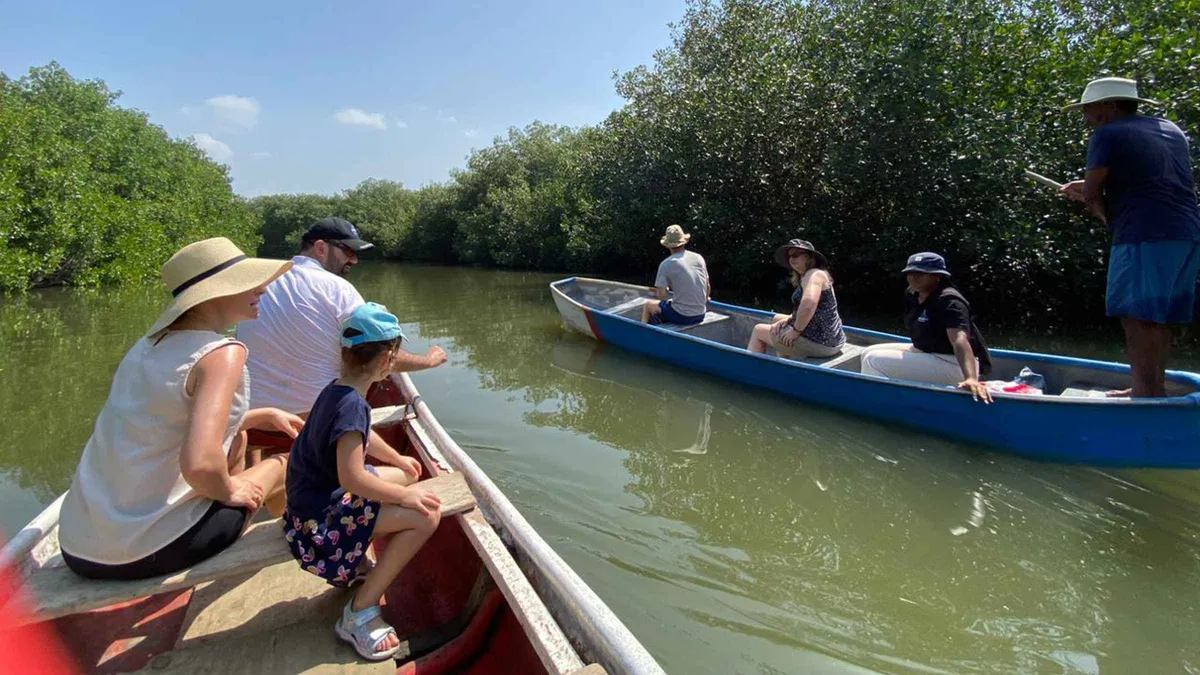
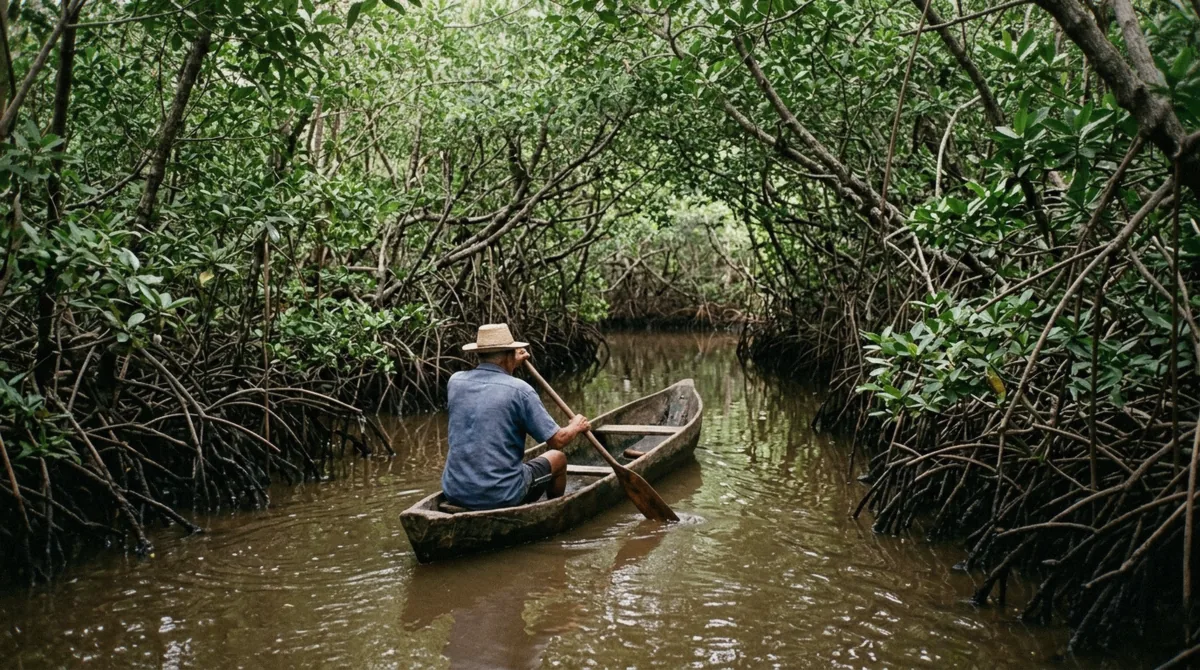
The fishing village at the city's northern edge where the mangrove canoe trips leave from. Half a day, a change of register, and some of the cheapest fresh fish around.
Seafood lunch add-ons on canoe tours are quoted around $22.20 (70,000 COP) and typical lunches around $12.69 (40,000 COP), both from tour operator pages rather than any official source.
A guided mangrove eco tour with transport runs $72.41 for two hours.
The Walled City, in the Order People Walk It
This is the route almost every visitor improvises on day one, and it happens to be chronological: the gate the city was entered through, the square it sold people on, the offices that taxed it, the church that argued with all of it, and the wall that kept it. Follow it in order and the old town explains itself.
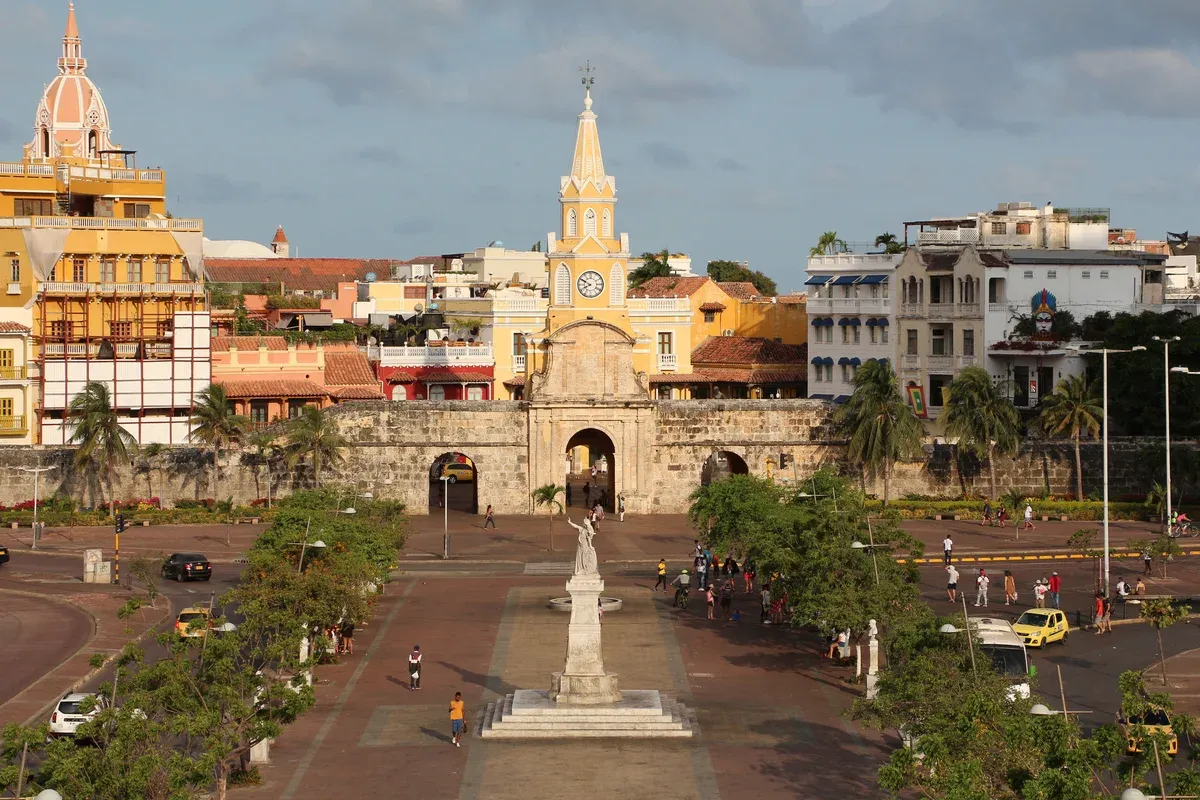
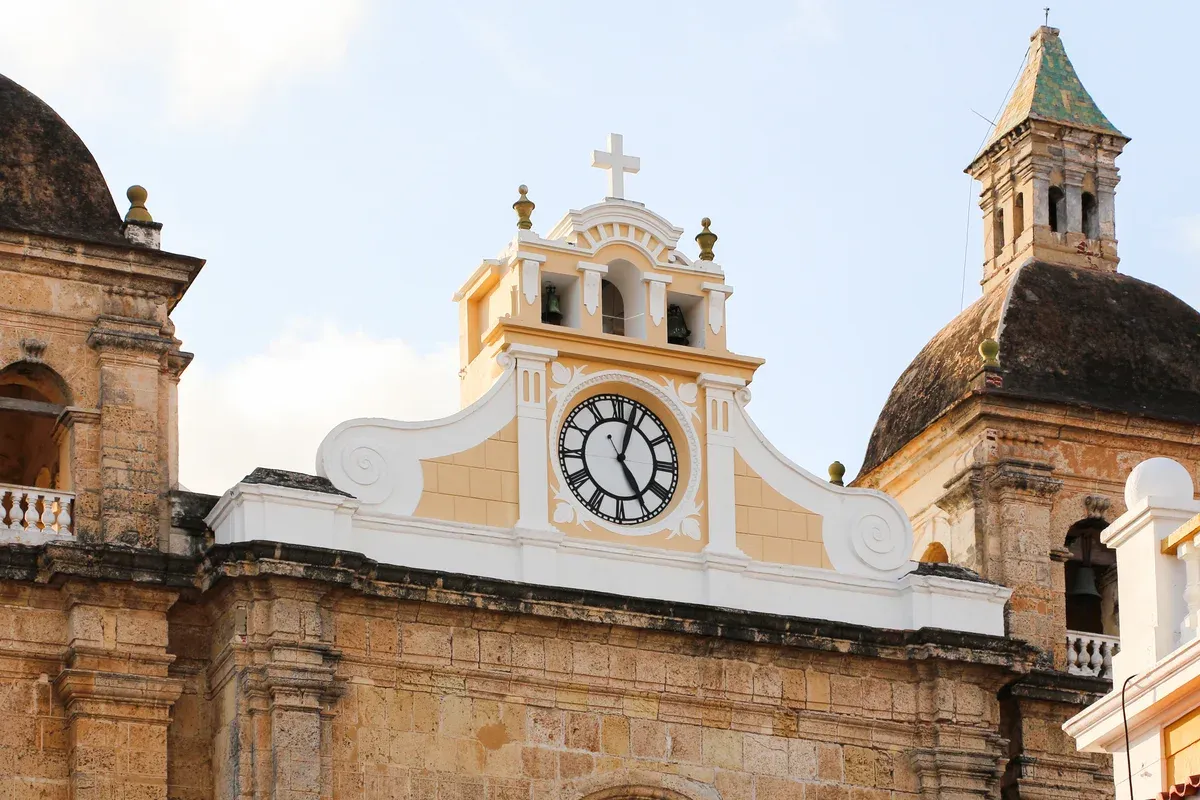
The Puerta del Reloj, the original land entrance to the walled city. Photo: Bernard Gagnon, CC BY-SA 4.0, via Wikimedia Commons
Torre del Reloj
Start at the clock tower. It was the city's main gate and it is still the reference point everything else is measured from, so the walk makes sense from here and from nowhere else. The Spanish knew it as the Boca del Puente, the mouth of the bridge, because a drawbridge once crossed the Canal de San Anastasio here and the canal was the only thing separating the walled city from Getsemani outside it.
The clock that gave the tower its current name was added at the beginning of the eighteenth century, long after the gate itself. Stand under the central arch and look at the three openings: the middle one was the entrance, the two flanking arches were a chapel and an armoury rather than doorways. There is no ticket, no gate and no hours page, because there is nothing to go inside.
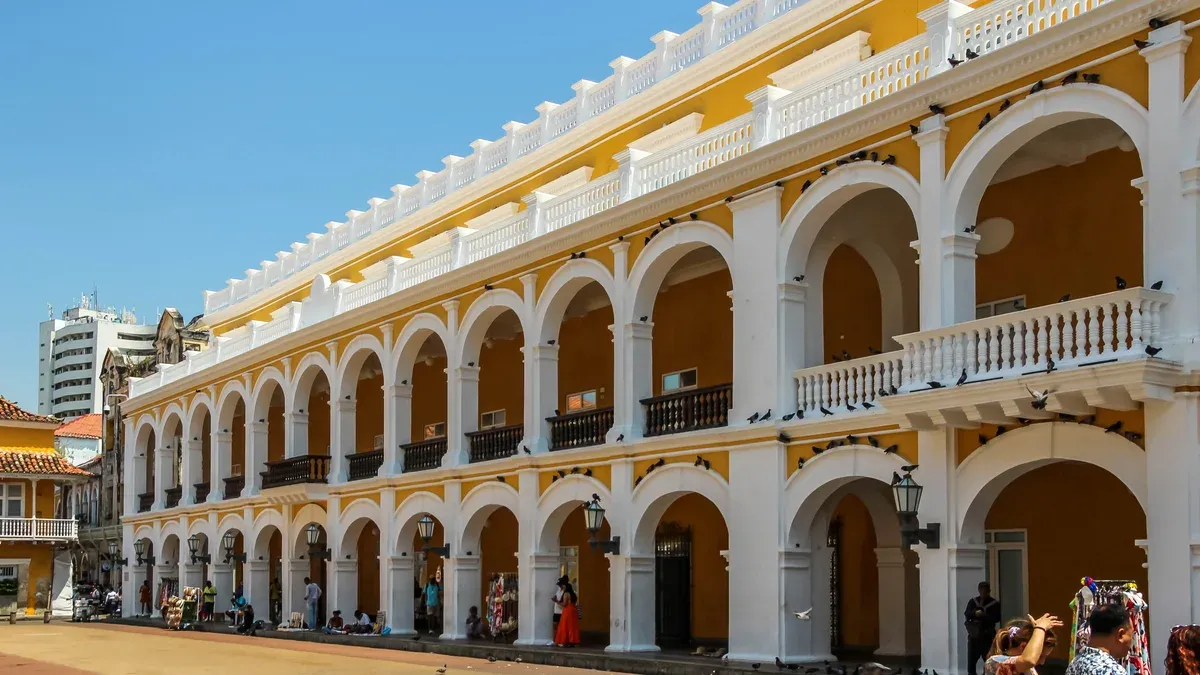
Plaza de los Coches and the arcade of the Portal de los Dulces after dark. Photo: Borges Gracián, CC BY-SA 4.0, via Wikimedia Commons
Plaza de los Coches
Walk through the archway and the triangular square on the other side is the Plaza de los Coches. This is the hardest piece of ground in the old town to walk over lightly. By the seventeenth century Cartagena was one of the two licensed slave ports of the Spanish Americas, and the market where captives were sold stood on this square.
The arcade along its eastern side, now the Portal de los Dulces and a row of sweet stalls, is the same colonnade the trade ran under. The statue in the middle is Pedro de Heredia, who founded the city in 1533. Nothing here is signposted at the scale the history deserves, which is one reason a guided walk is worth it on a first morning.
It is also where the fruit-seller and hat-vendor pattern introduces itself, so a polite no works better here than anywhere.
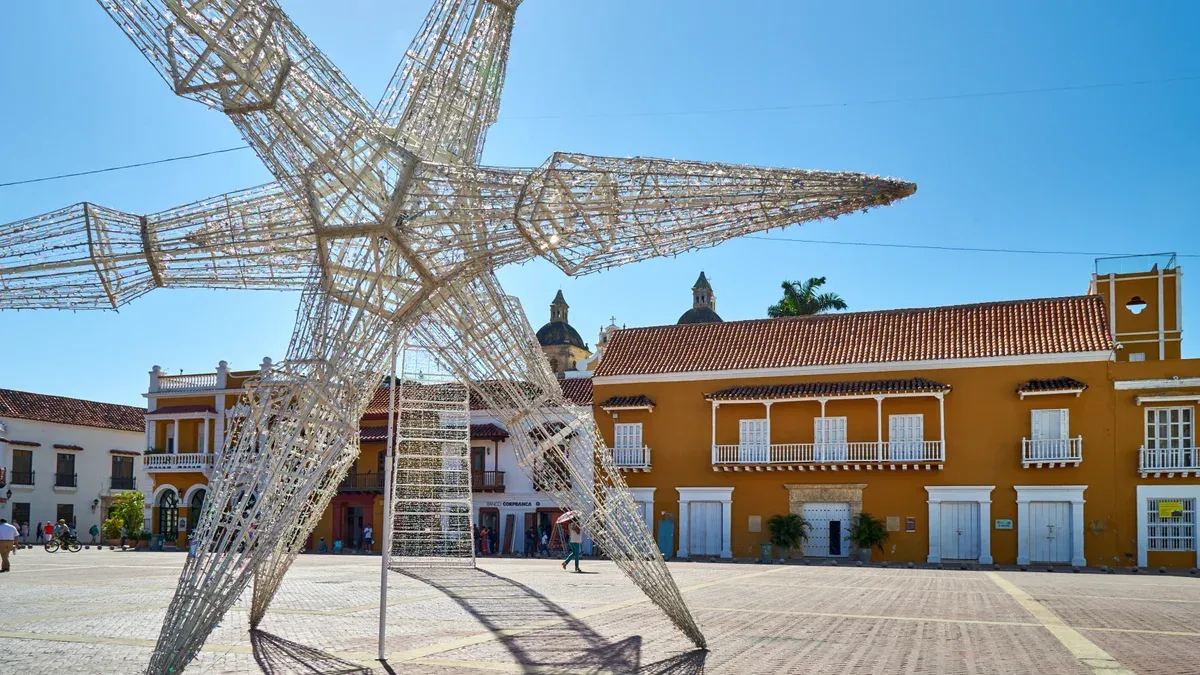
Plaza de la Aduana, the largest square inside the walls. Photo: Georg Karl Ell, CC BY-SA 4.0, via Wikimedia Commons
Plaza de la Aduana
One block on is the largest square inside the walls, and the one the colonial administration actually ran from. It was called the Plaza de la Mar when the water came closer, and the customs house that gives it today's name sat here to tax everything moving through the port, which in practice meant Bolivian silver going out and enslaved people coming in. The building is the city hall now.
The square is deliberately empty, which is why every walking tour stops here to talk: there is space to stand, shade at the edges and a view of three centuries of facades at once. Cross it diagonally and you are at San Pedro Claver.
The church and cloister of San Pedro Claver. Photo: Bernard Gagnon, CC BY-SA 4.0, via Wikimedia Commons
San Pedro Claver
The church, cloister and museum honour Pedro Claver, the Catalan Jesuit who arrived in 1610 and spent forty years meeting slave ships at the dock with water, food and medicine. He died here in 1654 and is the patron saint of enslaved people. His remains are under the high altar, which is the reason the building is a pilgrimage site and not only a monument.
This is the walk's first paid entry: $9.52 (30,000 COP) for a foreign adult, $6.66 (21,000 COP) for a Colombian adult, $6.98 (22,000 COP) for international children, students and seniors, and $2.54 (8,000 COP) for a resident of Bolívar. The ticket covers the cloister and museum, not a Mass, which runs on its own schedule. Full detail on San Pedro Claver.
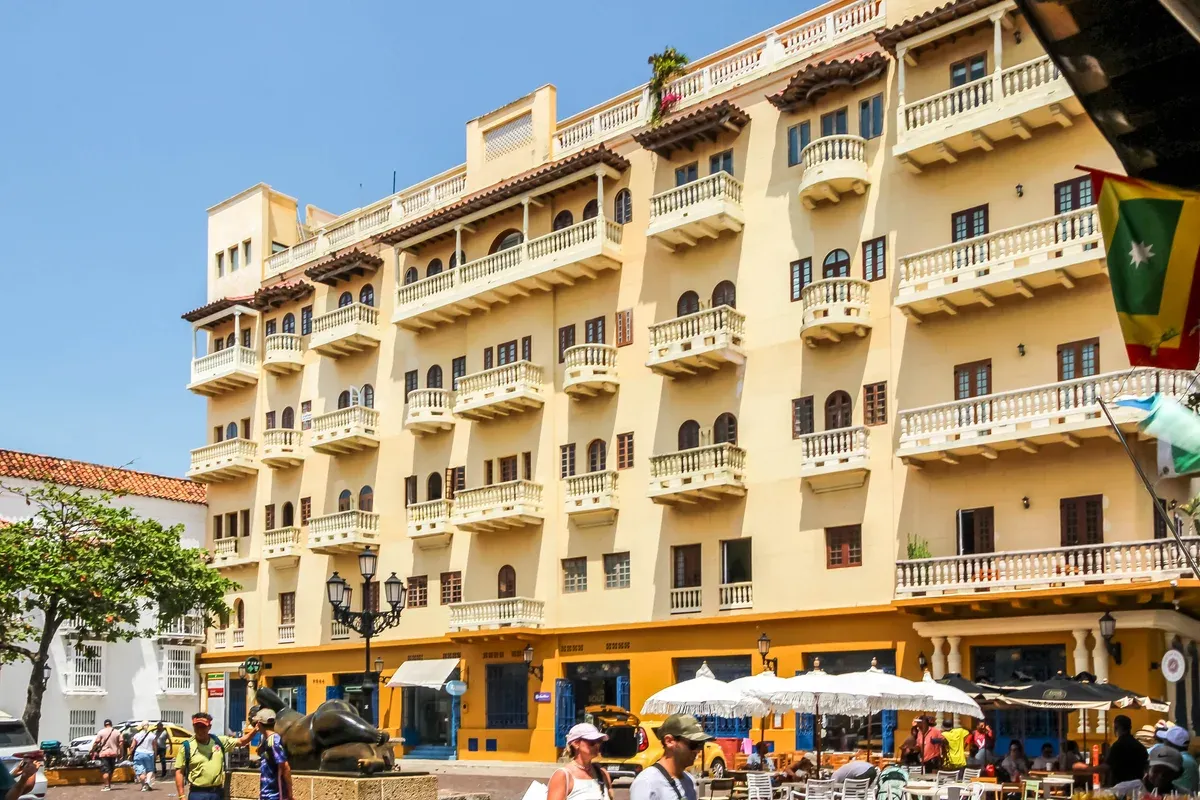
Plaza de Santo Domingo and the church's off-kilter tower. Photo: Dr. Thomas Liptak, CC BY-SA 4.0, via Wikimedia Commons
Plaza de Santo Domingo
Follow the lanes north-west and the square opens with the oldest church in the city on one side and Botero's reclining bronze woman in the middle. The church tower leans, visibly, and the story locals tell is that the devil tried to pull it down. This is the natural lunch and evening stop, because tables ring the whole square, and it is also where the old town is at its most expensive.
Prices here are set by the view. The cathedral a few streets away publishes no visitor price at all, because no diocesan page could be found that states one, so anything you read online about its entry fee is somebody's guess rather than a rate.
The seaward wall with one of its garitas. Photo: Joe Ross, CC BY-SA 2.0, via Wikimedia Commons
The wall itself
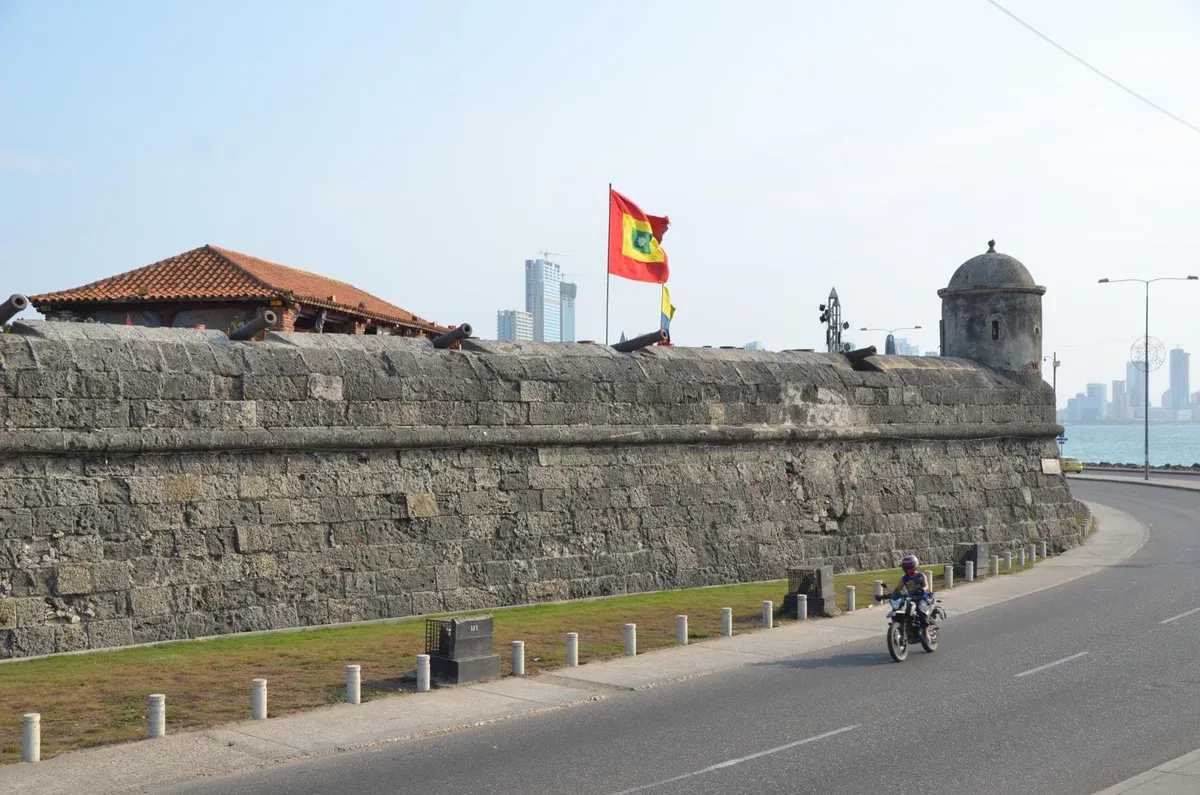
The walls exist because of one bad month. Francis Drake arrived in April 1586 with 23 ships and 3,000 men, burned 200 houses and the cathedral, and left only after the city paid a ransom. Spain answered by sending the engineer Bautista Antonelli, and the fortifications went up over the two centuries that followed, ending as the most complete defensive ring in South America and a UNESCO World Heritage site since 1984.
They worked: the British assault of 1741 failed against them. Climb up anywhere along the western side and walk the top toward the sea. There is no admission and no published hours page, so free and always open is the working assumption here rather than a posted rule.
Sunset from the rampart is the best free hour in Cartagena.
Las Bóvedas
Finish at the vaults built into the wall by the Santa Catalina bastion, the last piece of military building the Spanish finished here. The 23 chambers were stores and powder magazines, and later cells, which is why guides call them dungeons. They are shops now, selling hammocks, hats and souvenirs, and the sea is visible from the top of the structure.
It is the natural exit back toward Getsemani. The stop-by-stop version of this whole route, with walking order and opening times, is on Walled City, and the vaults have their own page at Las Bóvedas.
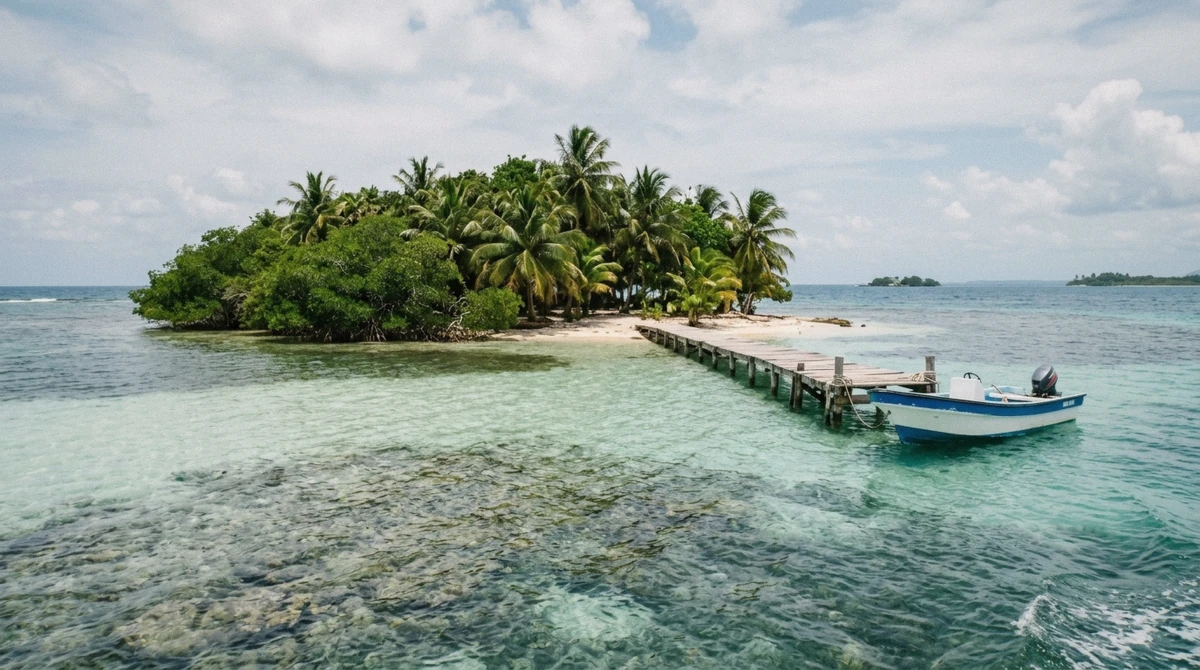
This is the number every Cartagena budget gets wrong. The advertised tour price is only the first line of a bill assembled at the dock, and this page is the only place that lays out all the lines side by side. The figures come from operator pages, the national park's own site and published press reports, and where sources disagree the disagreement is shown rather than smoothed away.
The five lines on the bill
Start with honesty about the evidence. No authority publishes a tariff page for the Muelle de la Bodeguita port charge. Operator sites quote between 17,000 and 41,000 COP per person, and different sources bundle different things into it, which is why the range is wide and stays wide.
The park's own page prints one line only, 11,000 COP for the San Bernardo sector, and the fee for the rest of the protected area circulates as a press-relayed figure attributed to a 2025 resolution rather than appearing on the park's tariff page itself. An accident insurance fee is another wrinkle. Press reports citing a 2024 resolution call it mandatory at $2.79 (8,800 COP), while the park's own visitor page describes insurance as recommended rather than compulsory and names two insurers.
On the beach, no official source publishes a current price for a chair or lunch. The last municipal vendor table is from 2022 and is likely superseded, so the same applies to the snorkel add-on. Ask at the dock, in pesos, before you sit or swim.
Charge
Typical amount
Can you avoid it?
Who collects it
Islands day tour fare
$72.90 as sold by the most-booked multi-island tour, or less if you arrange the boat yourself
No, it is the trip itself
The tour operator or boat company
Muelle de la Bodeguita port charge
$5.39 to $13.01 (17,000 to 41,000 COP), range across operator quotes
Only by going to Playa Blanca by road instead of by boat
Collected at the dock before boarding, no official tariff published
National park entry, San Bernardo sector
$3.49 (11,000 COP), per the park's own page
No, it is collected for entering the protected area
Parques Nacionales Naturales
Beach chair or lunch
not stated, no official source publishes a current figure
Yes, bring your own water and eat before you sail
Beach vendors, priced per establishment
Optional snorkel stop
not stated, the 2022 municipal table is likely superseded
Yes, it is an add-on sold on the beach
Beach or boat vendors
What this means for your budget
A realistic floor for the day is the tour fare plus the dock charge plus park entry. On the most-booked tour that is roughly $81.80 (about 258,000 COP) before you eat or rent anything, and less if you cobble the boat together yourself. Anyone quoting a flat total without separating the port charge is hiding a line item, and the full comparison lives on Islas del Rosario.
These four cover the classic first-trip split: the old town on foot, the fort with a guide, the islands by boat and the street food. None of them covers Barú or the mangroves, which are separate days. Figures current in Q3 2026.
from $14.81
Cartagena: Historic Center and Getsemaní Shared Walking Tour
★★★★★★★★★★4.9(3,510 reviews)
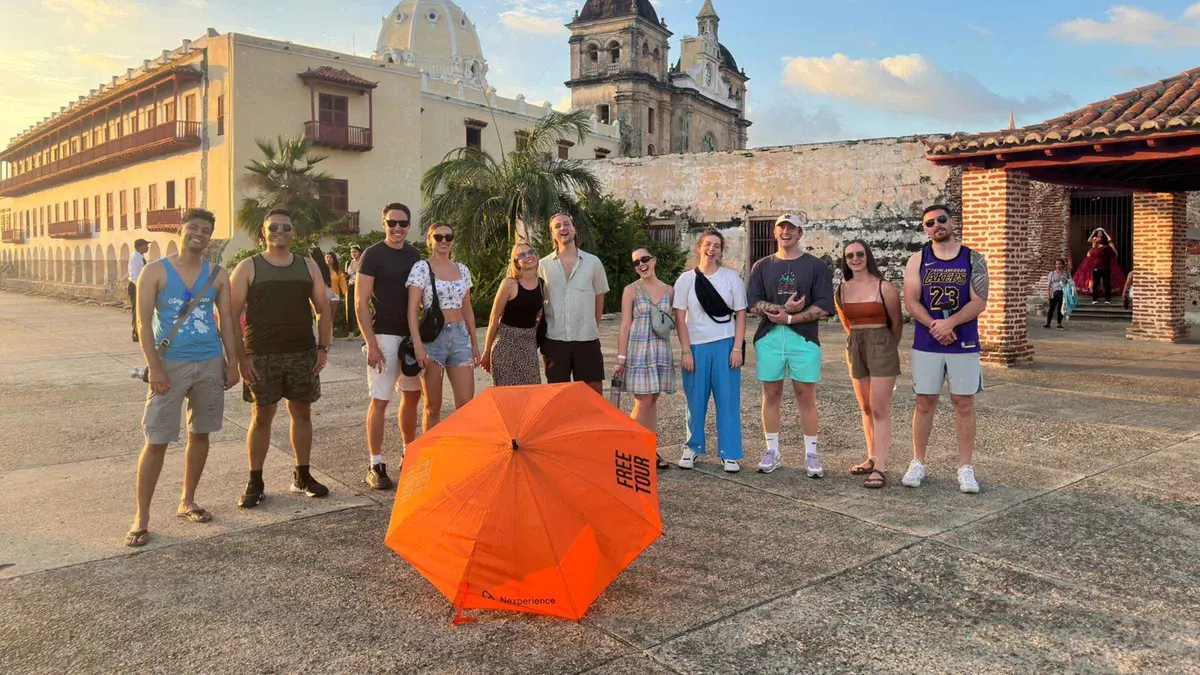
A shared 2.5-hour walk through the Walled City and into Getsemani, covering the slave-trade history, the Clock Tower and the plazas behind it. Groups can run large since it's a shared departure, and there's no seating or shade break built into the route.
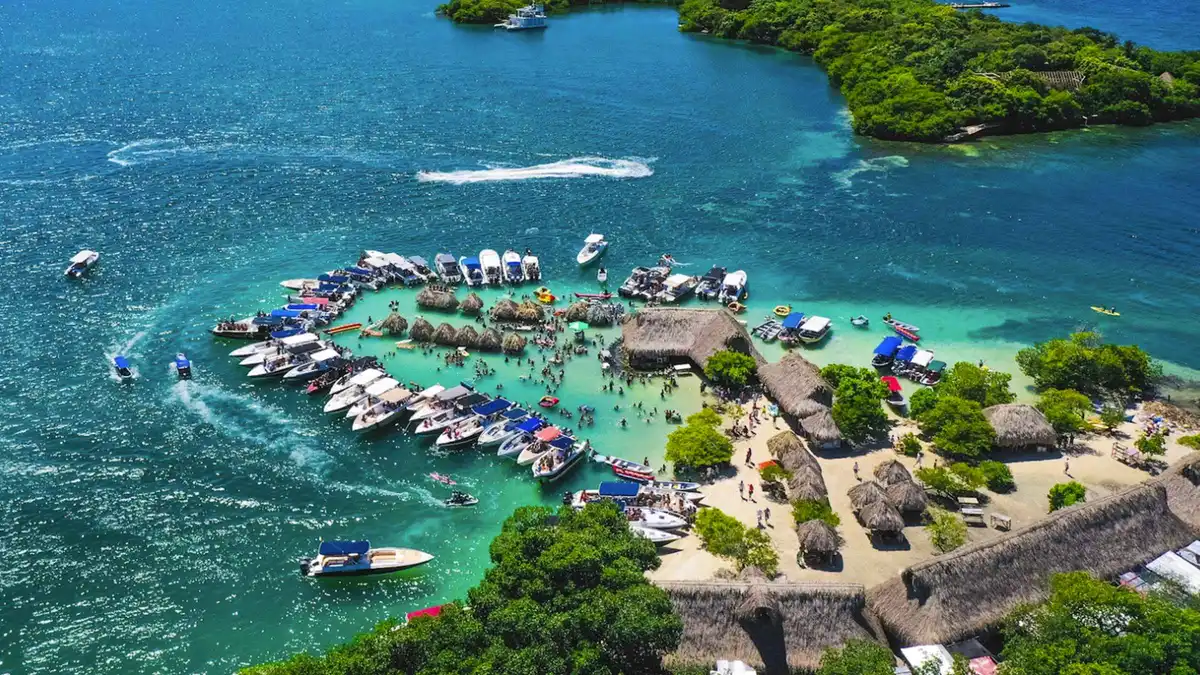
A 6.5-hour speedboat run to the Rosario Islands with two sightseeing stops, three island or beach club visits and lunch, plus an optional Oceanarium add-on. The Eco and VIP ticket tiers change which islands and boats you get, so the beach club shown in listing photos isn't guaranteed for every ticket type.
Cartagena: San Felipe de Barajas Castle Guided Walking Tour
★★★★★★★★★★5.0(43 reviews)· 2 hours
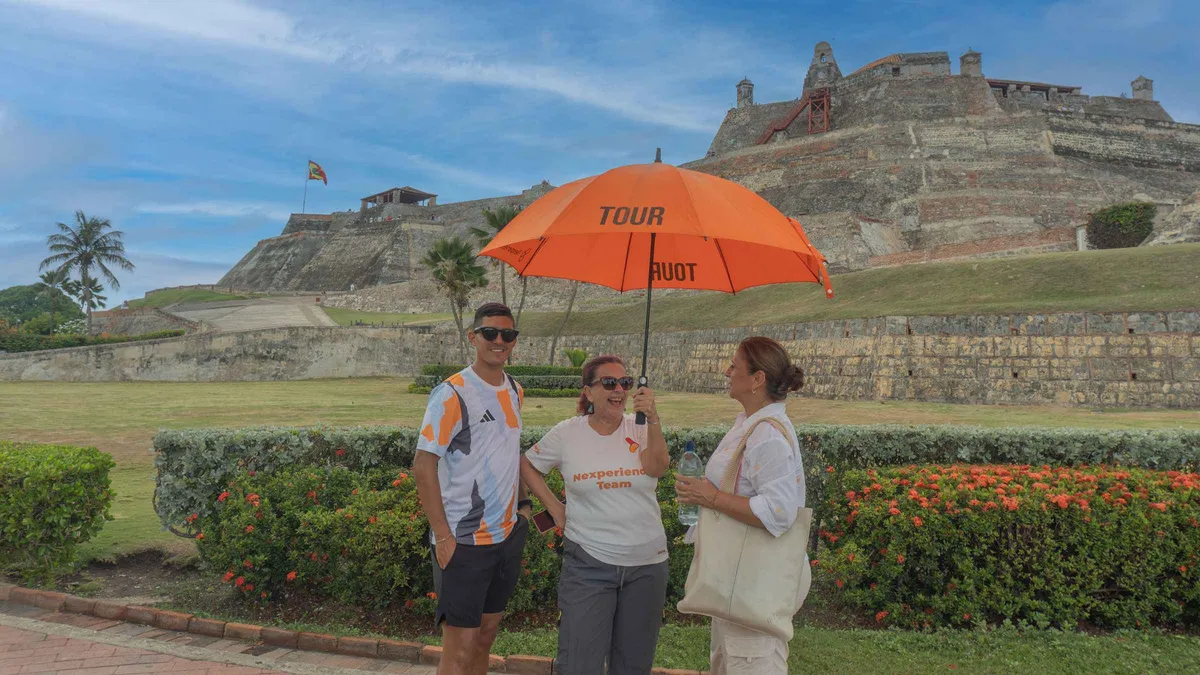
A 2-hour guided walk through Castillo San Felipe de Barajas with skip-the-line entry through a separate gate, covering the fortress tunnels and the 1741 siege. One reviewer flagged historical inaccuracies from a specific guide, so it's worth asking follow-up questions if something sounds off.
Cartagena: Guided Street Food Tour with 10+ Tastings
★★★★★★★★★★4.9(1,046 reviews)
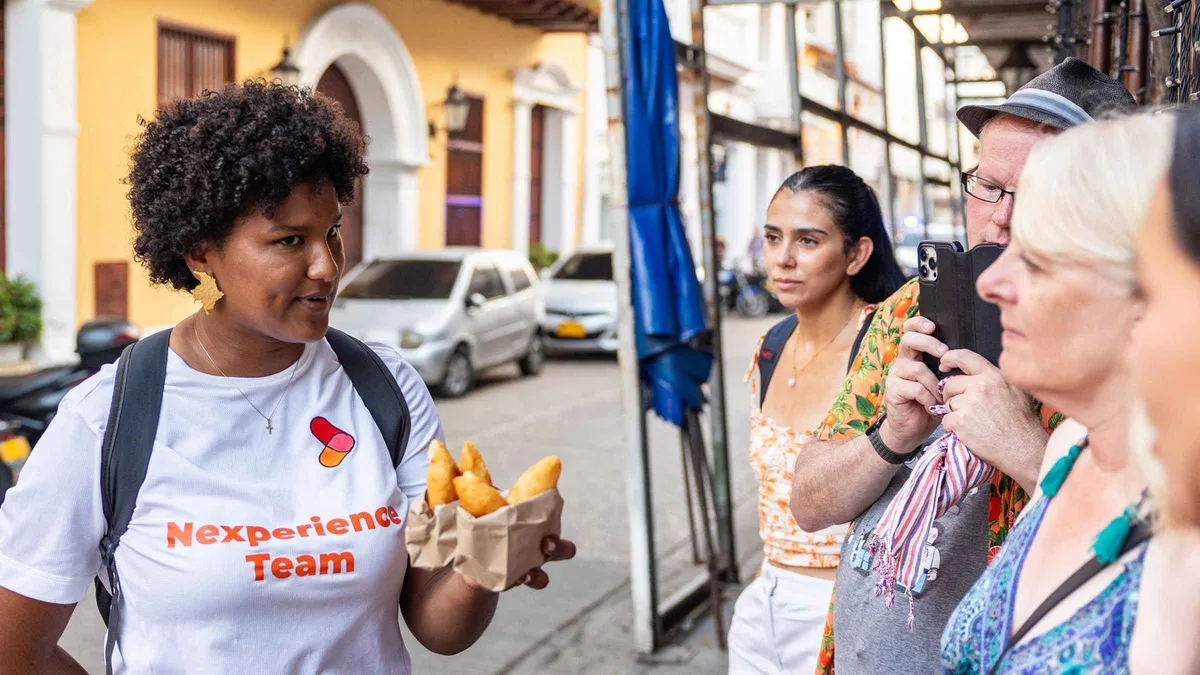
A shared 2.5-hour tasting walk through the Walled City covering 9 to 10 Colombian street foods and drinks, ending near a specialty coffee stop. It's a shared departure with no stated group cap, so it can run larger than the small-group food tours here.
Prices, ratings and details are the platform's own. dollar figures are the listed prices — the platform bills in your account's currency.
How Many Nights Cartagena Needs
The honest answer depends on whether the islands are on your list. The table maps nights to what fits, and each row links to a full itinerary.
Nights against plans
Two nights is the compressed version and it works only if you skip the islands. Three is the sweet spot for a first visit, because the island day deserves a full day rather than being squeezed into an afternoon. Four and five let you split the museums, add Barú or the mangroves and still keep a slow morning.
Anything longer and you are likely taking day trips every other day, which the day trips page handles. The row-level detail below assumes the fort at $12.06 (38,000 COP) and the monuments in the centre, none of which need more than an hour or two each.
A cruise call, a layover or a single night gives you roughly eight usable hours, and the heat decides how you spend them. Below is what fits, in what order, and three routes that actually work depending on when your day starts.
The rampart, where a one-day visit should finish. Photo: Joe Ross, CC BY-SA 2.0, via Wikimedia Commons
The rule the day turns on
Cartagena is hot from eleven until four, with humidity that makes walking the walls at noon genuinely unpleasant. Everything else follows from that. Put the walking at the start and the end of the day, put anything indoors or air-conditioned in the middle, and never plan the island trip: the boats leave between 07:30 and 09:30 and return between 15:00 and 17:00, so a Rosario day is the whole day or nothing.
The fort opens at 07:00, earlier than every museum, which makes it the one place worth being at on the hour it opens.
Route A, the classic first day
Best if you are staying the night and can start early. Torre del Reloj at 08:00, then the walk in order through Plaza de los Coches and Plaza de la Aduana, San Pedro Claver at $9.52 (30,000 COP) for a foreign adult when the doors open, and Plaza de Santo Domingo for a long lunch while the heat peaks. Museums from 15:00, the Palacio de la Inquisicion at $7.61 (24,000 COP) or the free Museo del Oro Zenu, then up onto the wall for sunset and dinner in Getsemani.
Best if you land mid-morning with a fixed return. Take the fort first, Castillo San Felipe at $12.06 (38,000 COP), because it is closest to the port side of the city and it empties out as your own ship's crowd moves on. From there into the walled city for the compressed loop: gate, Coches, Aduana, San Pedro Claver, and the wall at Baluarte de Santo Domingo.
Skip the museums entirely. Buy nothing on Plaza de los Coches. If you have ninety minutes to spare at the end, spend them on the wall rather than in a shop.
Route C, the late start
Best if you arrive at midday, or if the morning is gone. Start indoors: two museums back to back, then the walled-city walk from 16:00 when the stone gives its heat back and the light is worth the photographs. Sunset on the wall, dinner in Getsemani, and Plaza de la Trinidad afterwards, which is where the city actually sits outside in the evening.
You will miss the fort. That is the correct thing to drop in this version, because it closes at 18:00 and it is the one stop that rewards a fresh morning.
What to drop, in order
If the day compresses further, lose things in this order: the museums first, then the fort, then the paid church interiors, then lunch as a sit-down. The walk itself and the hour on the wall are the last things to go, because they are free, they are what the city is famous for, and they are the only two items on this list that cannot be done better somewhere else.
Hours you have
Do this
Skip this
3 or fewer
The gate, the three squares, and the wall at the end
The complete first visit, with the islands on day three.
Budget the island day at the fare plus $5.39 to $13.01 (17,000 to 41,000 COP) at the dock plus park entry.
Book the boat tour before you arrive in high season.
Eating in Cartagena Without the Tourist Markup
Food is where the walled city's prices detach from local reality. The pattern for eating well and cheap is consistent and easy to copy.
The arepa de huevo, split. Photo: Jdvillalobos, CC BY 3.0, via Wikimedia Commons
The fried things, and where they come from
The coast eats fried corn, and the arepa de huevo is the local proof: a disc of ground corn dough fried once, opened, filled with a raw egg, then fried again so the egg sets inside. It belongs to the Caribbean coast rather than to Colombia generally, and the Andean interior has nothing like it. Around it sit the rest of the fritos, the carimañola of cassava dough stuffed with meat, the empanada, the buñuelo of black-eyed pea flour.
They are sold from glass-fronted carts and cost a few thousand pesos each. No official source publishes the prices, so ask before the tongs move, and expect the visitor rate on Plaza de los Coches and the local rate three streets inland.
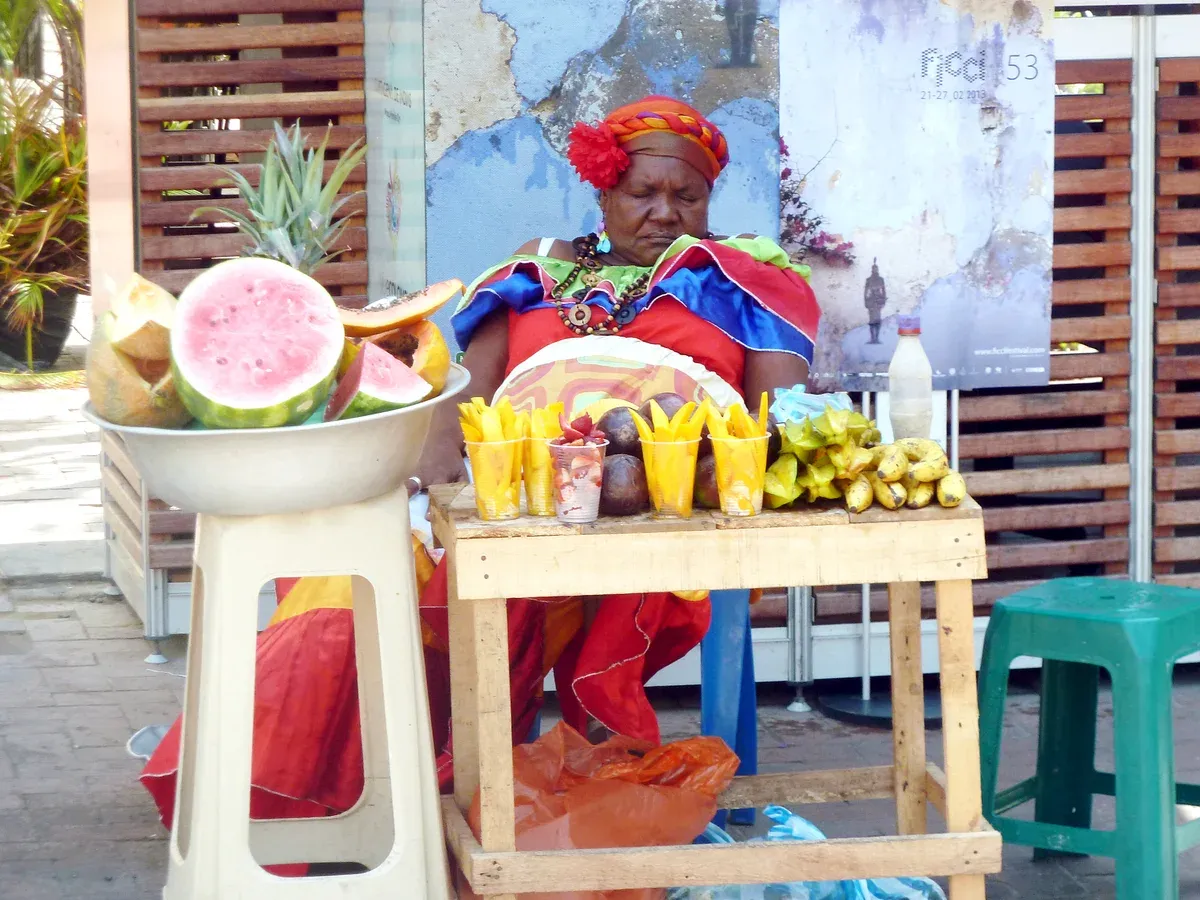
A palenquera selling fruit on Plaza de San Pedro Claver. Photo: David Shankbone, CC BY 3.0, via Wikimedia Commons
The fruit sellers are not a costume
The women selling fruit from bowls balanced on their heads are palenqueras, and most trace to San Basilio de Palenque, the town founded by people who escaped slavery and the first free settlement in the Americas. Selling fruit in the city was how that community earned in Cartagena for generations, and the dress is work clothing that became an emblem, not a tourist invention. The transaction, though, is a transaction.
A photograph is charged for, the fruit is charged for separately, and neither price is posted. Agree the number first, in pesos, before the bowl comes off her head or the phone comes out. Do that and it is a fair trade on both sides.
Mercado Bazurto. Photo: Xemenendura, CC BY-SA 4.0, via Wikimedia Commons
Bazurto, where the city actually shops
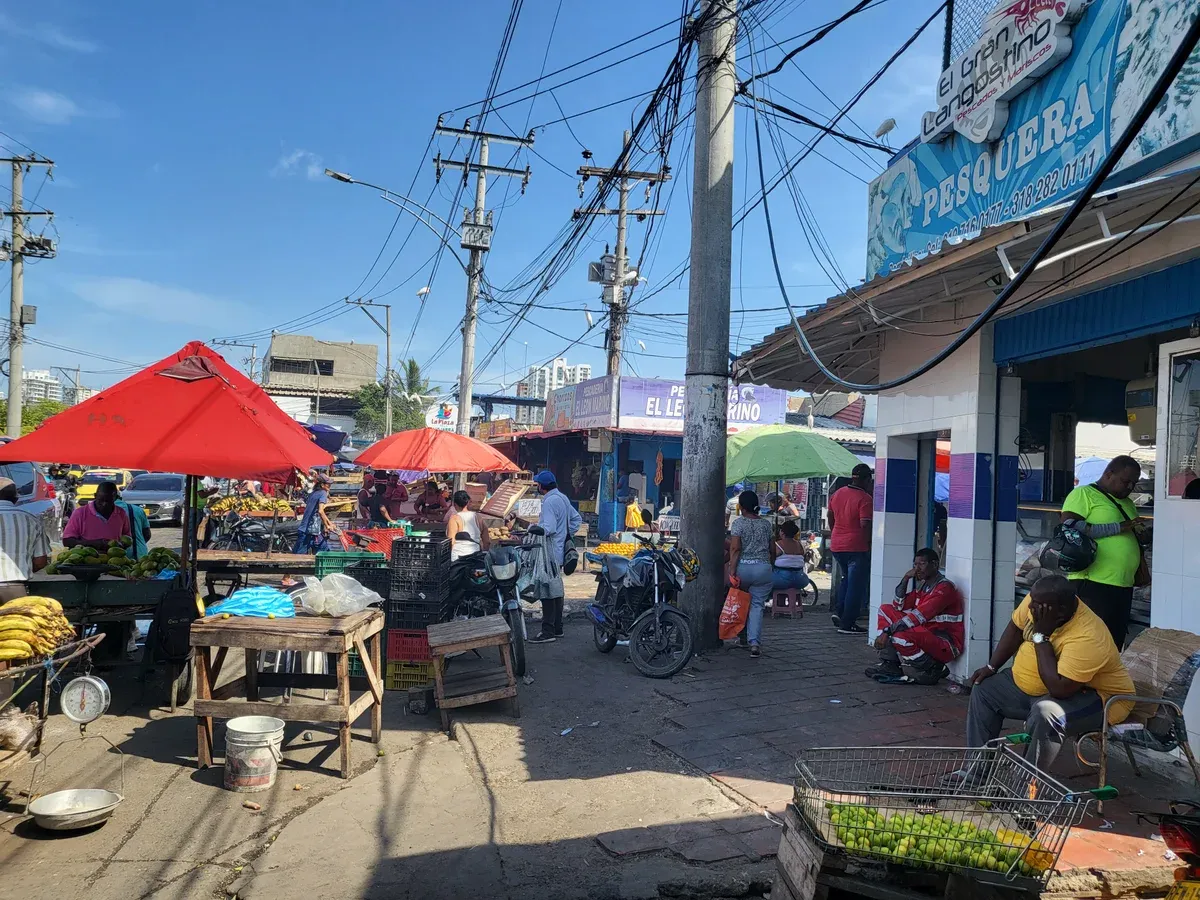
Bazurto is the working market outside the walls, and it feeds the whole city including the restaurants inside them. It is loud, wet underfoot and organised by logic nobody explains to visitors, which is why the normal way in is with a guide who knows the fish side from the fruit side. Nothing there publishes hours or prices.
Go early, because the fish is sold and cleared before the heat arrives, eat what is being eaten around you rather than what is offered to you, and leave the watch at the hotel. The Mercado Bazurto page has the detail and the honest warnings.
Sitting down, and the 10 percent question
A sit-down bill in Cartagena arrives with a voluntary service charge of 10 percent on it. Colombian law makes it voluntary in the real sense: the establishment must ask whether you want it added, and you may decline without argument or consequence. In the tourist squares it is often added silently and then defended if you query it, which is your cue to query it politely anyway.
Where to eat well rather than expensively is on where to eat, and what the local dishes actually are is on typical food.
Cartagena has a base temperature and then it has festival weeks, when rooms triple and the streets stop working in the best possible way. Two dates are fixed and worth planning around, one is a national holiday, and one is not a date at all but a pattern.
The Palacio de la Proclamación on Plaza de la Aduana. Photo: Dr. Thomas Liptak, CC BY-SA 4.0, via Wikimedia Commons
The independence fiestas, around 11 November
On 11 November 1811 Cartagena declared absolute independence from Spain, and it did so before the rest of the country, which is the part the city has never stopped celebrating. The declaration was pushed by the artisans and free black population of Getsemani as much as by the criollo elite, and that is still visible in the shape of the modern festival: the formal civic acts happen inside the walls, the street version belongs to Getsemani. The 2026 programme runs preludes from October, the swimsuit parade on Plaza de la Aduana on 6 November, the solemn session and floral offering on 11 November, concerts on 13 and 14 November and the Cabildo de Getsemani on 15 November.
The district lists it as intangible cultural heritage. Rooms inside the walls sell out months ahead and prices spike hard. Want the party, book early.
Want a quiet city, take a different week.
Hay Festival, late January
The Cartagena edition of the Hay Festival puts writers, journalists and musicians into the courtyards, theatres and churches of the old town for four days, and it has grown into the biggest literary gathering in the Spanish-speaking Americas. The next edition runs 28 to 31 January 2027, with tickets going on sale the November before. Many sessions are in Spanish, several are free, and the ticketed ones in the small venues sell out first.
January is pleasant weather anyway, in the driest stretch of the year, so this is a question of taste rather than avoidance: the city is fuller and more interesting at the same time.
Semana Santa
Holy Week is Colombia's own travel season, so domestic visitors pile on top of foreign ones. Beaches, boats and hotels run at capacity, processions reroute movement through the centre, and some offices and smaller museums shorten their hours. Exactly which ones, and by how much, is not published anywhere official that we could find, so treat any specific closure list you see online as a guess.
Book everything early or pick another week.
Cruise days, all season
Cartagena's cruise terminal sits across the bay, and when two or three ships dock the fort and the old town absorb several thousand day visitors between mid-morning and late afternoon. No official arrivals calendar could be found, so the pattern rather than the schedule is the useful thing: passengers move in a predictable loop, fort first and walled city second, and they are gone by late afternoon. The fix is free.
Do the fort at opening, the museums after four, and keep the beach for the days the port is empty. The month-by-month version is on Events Calendar, and the weather side of the same question is on Best Time to Visit.
Almost nothing bad happens to visitors in Cartagena that is not on this list. Every line is a fix you can apply on the spot. The longer version is on Safety and Scams.
Do
Do agree the taxi fare before the door closes, because taxis have no meters and the fare is whatever was negotiated.
Do confirm any beach service price in pesos before you sit in the chair, because the price quoted in the sand rarely matches the bill at the end.
Do keep your drink in your hand and in sight in bars and clubs, because drink spiking is the reported pattern in nightlife districts.
Do use the official taxi rank or a ride app at the airport, because the arrivals hall touts charge whatever they think you will pay.
Do carry small notes, because vendors, drivers and market stalls rarely have change for large bills.
Don't
Don't follow anyone who says the emerald or gold shop has a special tourist price, because the pitch ends in an overpriced stone and a commission for the guide.
Don't accept the free bracelet, photo or 'gift' on the beach or in Plaza de los Coches, because the gift becomes an insistent charge.
Don't leave your phone or bag on the table at sidewalk cafes, because snatch theft from tables is the most common petty crime reported by visitors.
Don't drink the tap water, because the safe pattern in Cartagena is bottled or filtered water even though many locals drink from the tap.
Don't pay the 10 percent service line on a restaurant bill automatically, because by law it is voluntary, must be requested and can be refused.
Getting Around Cartagena
The city is small enough that transport is a solved problem once you know three fares and one rule.
Plaza de los Coches, where most walked days begin and most taxi fares are agreed. Photo: Borges Gracián, CC BY-SA 4.0, via Wikimedia Commons
Transcaribe, the bus rapid transit system
The Transcaribe trunk line runs from the southeast of the city through the centre and up to La Boquilla. The single fare is $1.24 (3,900 COP), set by a mayoral decree in force since January. Registered students, older adults and Sisbén A/B users get a $0.32 (1,000 COP) discount under a separate decree, which does not apply to visitors.
It is the cheapest way to cover distance, and full routes are on Getting Around.
The walled city on foot
Inside the walls nothing is far enough apart to justify a vehicle, and the old town is small enough that people who plan taxi hops end up walking anyway. The catch is that no authority publishes walking times between the monuments, so every figure you see online is somebody's estimate, including ours. What is reliable is the shape of the place: one long axis from the clock-tower gate to Las Bóvedas at the far end, with everything on this site's walk strung along it, and the rampart running parallel as a shadeless alternative route.
Shoes matter more than distance here, because the streets are uneven stone and the cobbles are ankle-turning after rain. So does timing: the same walk is pleasant at eight in the morning and genuinely unpleasant at one in the afternoon, which is the real argument for doing the indoor stops at midday.
Taxis by agreed fare
Taxis have no meters here. Fares come off a fixed zone card and are agreed before the door closes, and the published minimum is genuinely in dispute: a press report on the district decree and a city government snippet give different figures for the same charge, so the table below prints both readings rather than picking one.
Charge
One reading
The other reading
Status
Minimum fare
$3.89 (12,250 COP)
$3.11 (9,800 COP)
Sources disagree, neither confirmed against the decree text
Night surcharge after 7:00 p.m.
$0.35 (1,100 COP)
$0.29 (900 COP)
Same conflicting sources
Short hop inside the old town
Agreed at the door
Agreed at the door
No published tariff for the trip itself
The airport run
Rafael Núñez sits unusually close to the city, which is the fact that shapes the whole journey: this is a short hop rather than an expedition, and the fare matters more than the time. Two authorized taxi ranks operate at arrivals, and the published zone fares put the historic centre at $4.06 (12,800 COP) and Bocagrande at $6.92 (21,800 COP). Those figures are press-relayed rather than confirmed, because the Alcaldía's own tariff page answered 403 when we went looking, so treat them as the expected range and agree the number before the boot closes.
Ride-hailing operates in a legal grey zone here and drivers often ask passengers to sit in front. A booked transfer removes the negotiation entirely for $15.40 and up, which is the version that suits a late arrival or a first night. Full detail on the airport.
Three day budgets built only from figures with a source, mostly monument tickets and transport, with food left as an honest allowance since no official source publishes restaurant prices.
Three budgets, line by line
The shoestring day buys the free walled city, the wall at sunset and a Transcaribe ride, at $1.24 (3,900 COP) of hard transport cost plus street food at whatever the cart asks. The mid-range day adds the fort at $12.06 (38,000 COP) and one museum at $7.61 (24,000 COP), either the Inquisition palace or the Naval Museum, both priced on official pages. The top-range day swaps in a guided fort tour at $14.81 and reserves the island day separately at the fare plus the dock charges, which is budgeted on its own page rather than averaged here.
Accommodation is excluded from all three because it dominates the total and belongs to the neighbourhood decision.
Budget
Paid entries
Transport
Food basis
Rough day total
Shoestring
Nothing paid, the wall and plazas are free
$1.24 (3,900 COP) Transcaribe
Street food, no official price published
From $1.24 (3,900 COP) plus food at cart prices
Mid-range
Fort $12.06 (38,000 COP) plus one museum $7.61 (24,000 COP)
$1.24 (3,900 COP) Transcaribe, taxis by agreed fare
Local lunch out of the old town, market option
$21.50 (67,900 COP) of fixed costs plus food
Top-range
Guided fort tour $14.81, plus San Pedro Claver $9.52 (30,000 COP)
Taxis by agreed fare
Old-town dinner, the priciest end
$24.30 plus food and the island day if taken
Where the money actually goes
Fixed costs in Cartagena are low. The fort is the single most expensive mandatory ticket at $12.06 (38,000 COP), and everything else you must see is free or under ten dollars. The budget is decided by three choices: the hotel, the restaurant and the island day.
Each of those has its own page, starting with Cartagena Costs.
The hotel decision in Cartagena is really a neighbourhood decision, and the three areas are not variations on the same thing. One is inside the wall, one grew up outside it because it had to, and one was built on sand in living memory.
Centro Histórico, inside the wall
The most expensive beds in the city are in restored merchant houses behind the wall, and part of what you pay for is the building itself: these are seventeenth and eighteenth century courtyard houses, built around a patio so the air moves, with the balconies that make the postcards. The address buys walking distance to everything, which in practice means no taxi for sightseeing at all. It also buys noise.
Bars around Plaza de Santo Domingo and Plaza San Diego run late, and a room on the square is a room above a speaker. Ask for a courtyard-facing room, not a plaza-facing one, and the same hotel becomes a quiet one. Detail and the area map on Centro Histórico.
Getsemaní, just outside it
Getsemani sat outside the wall because that is where the artisans, free black families and dock workers lived, and the 11 November independence rising started here rather than in the mansions across the canal. It is a five to ten minute walk to the old town and noticeably cheaper, which has made it the default for budget and mid-range travellers and has been changing it fast. The noise here is Plaza de la Trinidad, which fills with people sitting on the church steps after dark and stays loud at weekends.
That is either the reason you booked it or the reason you should not. More on Getsemaní.
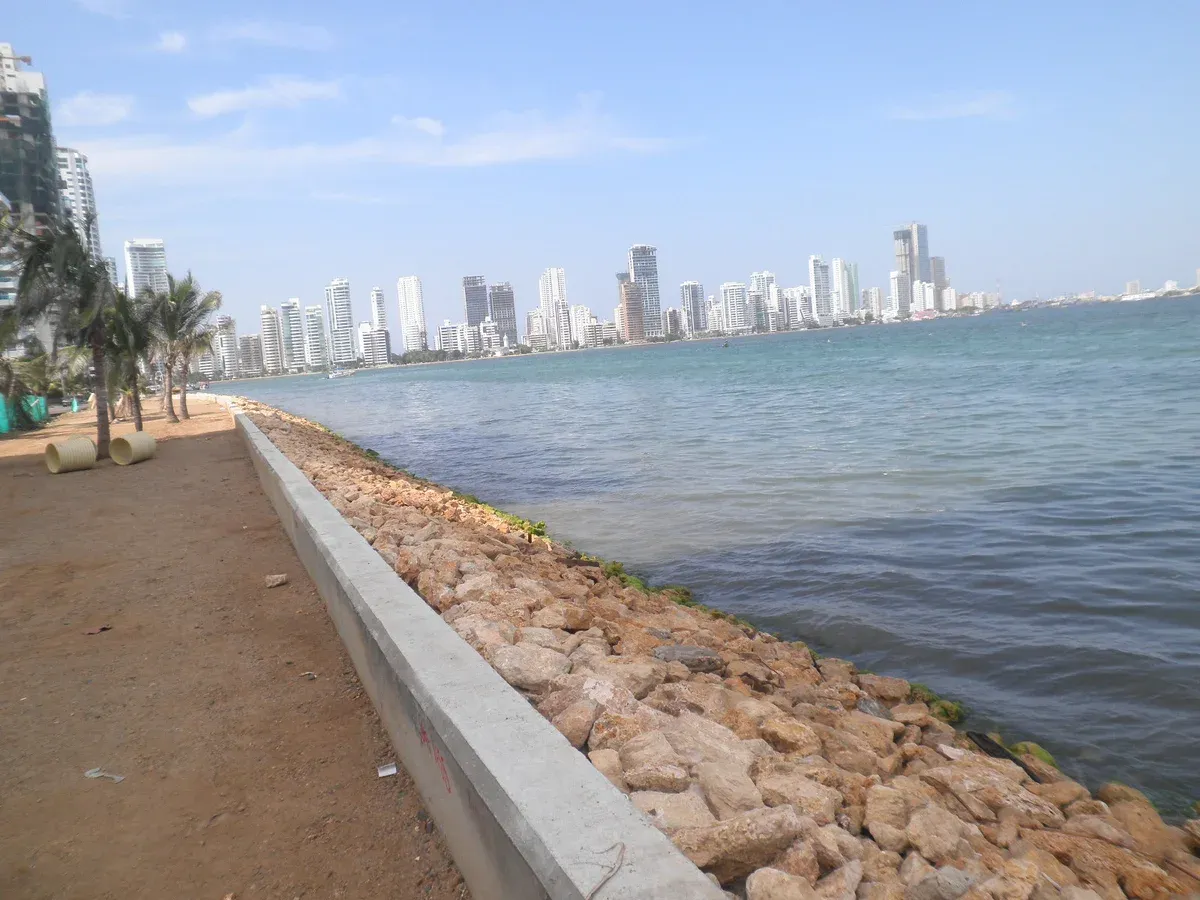
The Bocagrande shoreline. Photo: CivArmy, CC BY-SA 4.0, via Wikimedia Commons
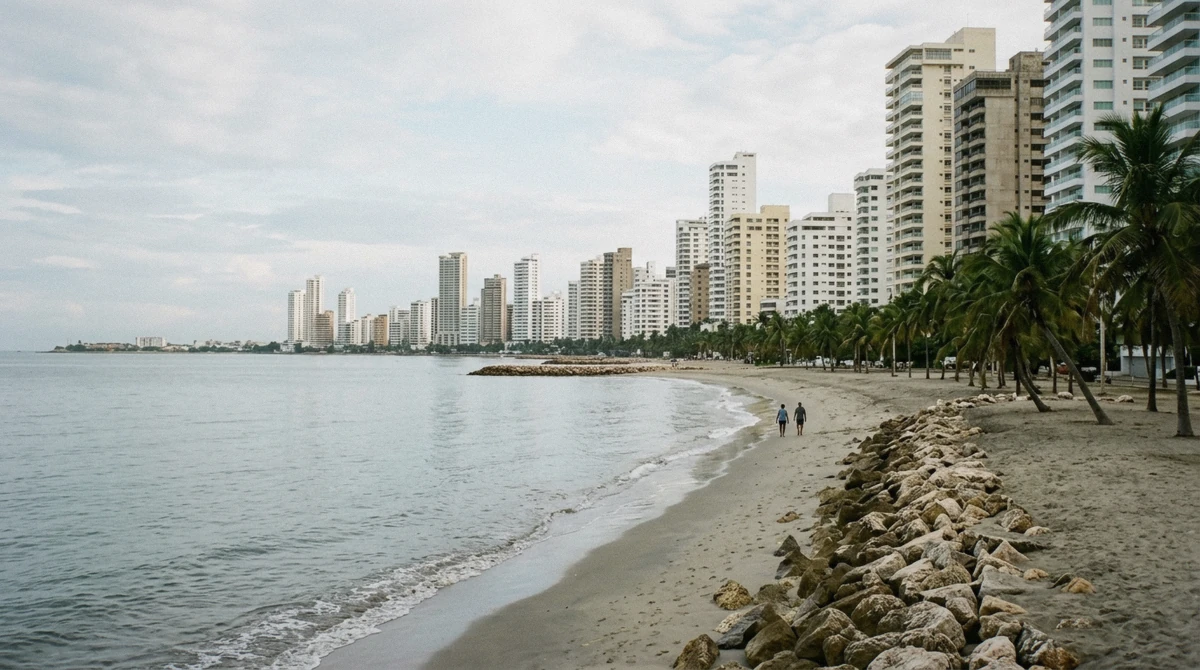
Bocagrande, the beach strip
Bocagrande is the modern peninsula of towers south of the old town, built on reclaimed sand in the twentieth century, which is why nothing there looks colonial. Hotels are high-rise and often mid-priced between the other two areas. The trade is honest: every sight needs a taxi or a Transcaribe ride, the published airport fare here is $6.92 (21,800 COP) against $4.06 (12,800 COP) for the centre, and the beach is grey-gold and busy with vendors rather than white and quiet.
It suits a family that wants a pool and a lift, and it suits nobody who came to walk the walls at dawn. Full comparison on Bocagrande and Where to Stay.
Four trips cover the range: mud volcano, heritage town, mangroves and birds. None of them covers the Rosario Islands, which own their own page.
from $27.55
From Cartagena: San Basilio de Palenque Tour
★★★★★★★★★★4.5(53 reviews)
A day trip to San Basilio de Palenque, the first free African town in the Americas, with a local lunch and an optional drum show. Round-trip transportation is a separate line item rather than built into the base price, which one reviewer used to book cheaper transport themselves.
A full day combining the Volcan del Totumo mud bath with a beach club afternoon and lunch, with the volcano entry ticket and transport included. It's explicitly not suitable for pregnant travelers or anyone with mobility impairments, since getting in and out of the mud crater involves informal steps.
Cartagena: Mangrove Eco Tour & Fishing with Transportation
★★★★★★★★★★4.8(225 reviews)· 2 hours
A 2-hour eco tour through La Boquilla's mangroves with hands-on traditional fishing and hotel pickup included. Several stops in the itinerary are marked optional, so the exact route can vary by departure.
Cartagena: Aviary National Park Tour with Hotel Pickup
★★★★★★★★★★4.8(22 reviews)· 5 hours
A half-day trip to the National Aviary of Colombia with hotel pickup and the entry ticket included, seeing over 135 bird species across 17 acres. One reviewer felt the 5-hour duration ran long against roughly an hour of actual aviary time plus a bird show.
Prices, ratings and details are the platform's own. dollar figures are the listed prices — the platform bills in your account's currency.
Six Questions Before You Go
The questions visitors ask before booking anything, each answered on the page that owns it.
Is Cartagena safe for a visitor?
The walled city and Bocagrande are policed and busy into the night, and the ordinary risks are theft, an unmetered taxi fare agreed too late, and drinks left unattended in Getsemani. The approach road to La Popa is the one place local operators tell you not to walk. The scams that are actually run here.
What does the island day really cost?
The fare is the start. A dock charge is collected at Muelle de la Bodeguita and national-park entry is collected on top, and no authority publishes a single tariff page for either, so operator quotes differ widely. The charges, line by line.
Which months bring the rain?
October is the wettest month of the Cartagena year and the trade winds blow hardest between December and April, which decides both the boat days and the beach days. Month by month, rain and wind.
How do taxis charge here?
Cartagena taxis run on fixed zone fares from a control card and not on a meter, so the fare is agreed before the door closes. Published minimum-fare figures disagree between sources. Fares, buses and the airport run.
Where should I sleep?
Centro is the short walk to everything and the highest price, Getsemani is the evening and the noise, Bocagrande is the beach strip and the towers. The neighbourhood decides the trip more than the hotel does. The three areas compared.
What is free in Cartagena?
Walking the wall, every plaza, the Torre del Reloj gate, Las Bovedas and the Museo del Oro Zenu, which the Banco de la Republica runs at no charge. What is worth your time.
Frequently Asked Questions
Is it safe to travel to Cartagena, Colombia right now?
Cartagena is a functioning tourist city where the realistic risks are petty: inflated taxi fares, beach vendor pressure, snatch theft from cafe tables and the emerald pitch. Normal city caution covers almost all of it, and the specific patterns with their fixes are laid out on Safety and Scams.
Is Cartagena good for tourists?
Yes, if you come for history, food and warm water. The walled city is compact and walkable, the fort costs $12.06 (38,000 COP), and there is a full activity set from islands to mangroves. The full inventory is on Things to Do.
What is Cartagena best known for?
The walled old town and the fortress of San Felipe de Barajas, the most complete Spanish colonial fortifications in the Americas, plus the Rosario Islands offshore. The route through the old town is mapped on Walled City.
Why do Americans go to Cartagena, Colombia?
Short flights from the United States, a Caribbean coast with an intact colonial centre, prices well below US resort towns, and no major timezone shock. That combination is why the city functions as both a city break and a beach trip, and the planning basics are on Plan.
How many nights do I need in Cartagena?
Two nights covers the walled city and the fort. Three is the first-visit sweet spot because it adds the islands as a full day. Four or more suits travellers adding Barú, the mangroves or Palenque. The full mapping is in How Many Nights Cartagena Needs.
What does the Rosario Islands day cost in total?
The tour fare, usually from $72.90 on the most-booked boat, plus a port charge of $5.39 to $13.01 (17,000 to 41,000 COP) collected at the dock, plus the national park entry of $3.49 (11,000 COP) in the San Bernardo sector. Chairs and lunch are extra at unregulated vendor prices. The line-by-line table is at What the Island Day Actually Costs.
Where should I stay in Cartagena?
Centro Historico puts you inside the walls and charges for it, Getsemani trades quiet for the evening and the music, and Bocagrande is the beach strip of towers a bus ride away. The six areas are compared on transport cost and what each suits at where to stay in Cartagena.
Cartagena on Video: Three Guides Worth the Time
Three filmed guides that cover what a written page cannot: the distances between plazas, the pace of the streets and what the island boats actually look like.
The Ultimate LOCAL Guide To Cartagena
A local's route through the old town and Getsemani, useful before you fix your walking order.
Video: Lonely Planet
Top 10 Things Do In Cartagena | Colombia Travel Guide
The ten places most visitors choose, filmed in the order they sit on the map.
Video: Kemoy Martin
10 Best Things To Do In & Around Cartagena
Covers the island and beach trips outside the walls, the part that costs the most to get wrong.
Video: World Wild Hearts
If the walled city is your first morning, the shared historic centre and Getsemaní walking tour at $14.81 is the highest-rated way to start it.
Free cancellation on most bookings, and a 4.9 rating from more than 3,500 travellers.
The office, phone and email above belong to the city's own visitor service and checked on 2026-09-18 — they are not this site's contact details. To reach us, use the contact page.
 Cartagena City Guide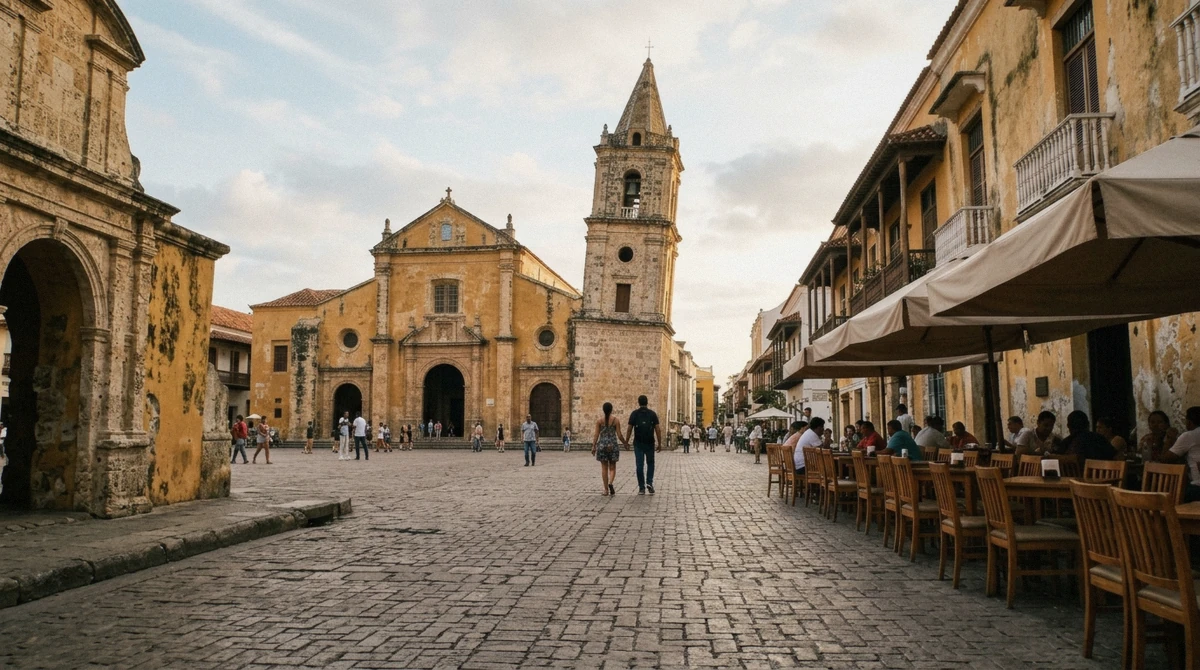
 from $14.81