 Cartagena City Guide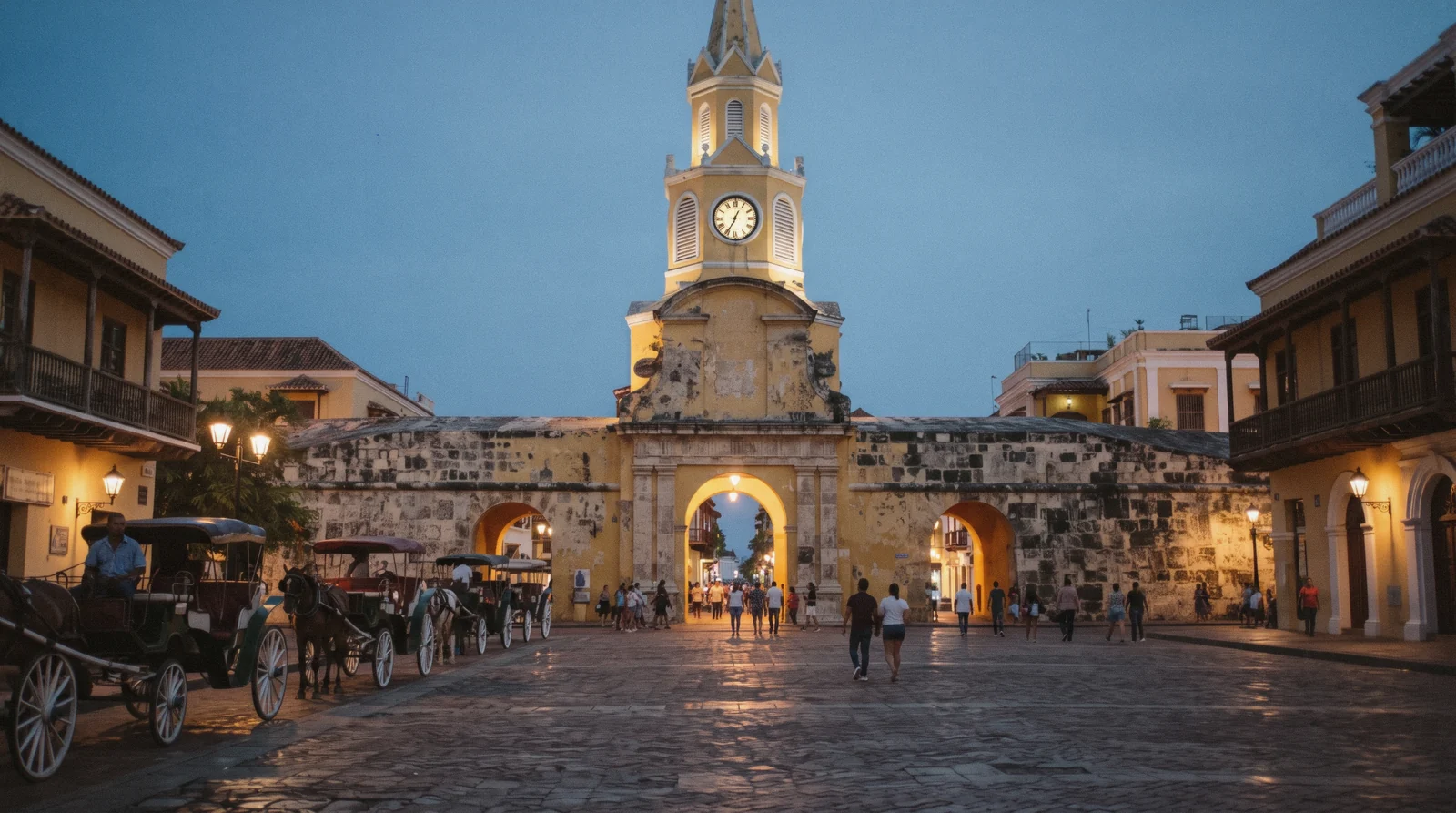
Torre del Reloj (Puerta del Reloj)
Torre del Reloj, Cartagena's clock-topped gate also called Puerta del Reloj or Boca del Puente, has marked the main entrance to the walled city since the colonial period. No official body sells a ticket for it or publishes a visitor page, because there is nothing to sell: the gate and the plaza in front of it are open public space, and the tower itself is not open to climb. This page in this independent Cartagena travel guide covers what the gate actually was, what's worth noticing as you walk through, and where it sits relative to Getsemaní and the rest of the walled city.
Quick answer Free, always open, and why the tower interior isn't part of the visit
Torre del Reloj is the main gate into Cartagena's walled city, and it costs nothing to walk through because it is a public street, not a ticketed monument. No authority, not the city, not ETCAR, publishes a visitor page for the tower because there isn't a visit to schedule: the clock tower itself is not open to climb, and what you're actually looking at is the gate, the plaza on either side, and the history behind both.
Key takeaways
- The tower marks the start of most walking tours of the historic center, including one that meets right at its base.
- Plaza de los Coches, on the Getsemaní side of the gate, was the city's old slave market, covered in the history section below.
- For the fortified walls this gate opens onto, see the full walled city guide, and for the souvenir arcade at the wall's other end, see Las Bóvedas.
Key facts
Opening hours
| Always (public gate and plaza) | No official hours published. It is a public street, not a monument with posted hours, and is always accessible |
|---|
Closed Never, it is a public street and gate
Admission
- Adult
- Free
- Reduced
- Free
- Free
- Free for everyone, there is nothing sold here
Planning it
- Time needed
- Not stated officially. Our routing: 5 to 10 minutes to look at the facade and read the historical marker, though most visitors pass through it several times a day just walking between the walled city and Getsemaní
- Address
- Puerta del Reloj, between Plaza de la Independencia and Plaza de los Coches, Centro Histórico, Cartagena de Indias
No fee applies to the gate or the plaza around it, confirmed against ETCAR's own reservations page for the historic center, which lists no admission or booking for the walls, Las Bóvedas, or Torre del Reloj specifically.
There's no ticket to compare here. The real question is whether you want to just walk through, or join a guided tour that starts at the gate itself.
| Option | Price | Includes | Cancel | Book |
|---|---|---|---|---|
| Free public accessEvery visitor, there is no alternative paid option | Free | The gate, the plaza on either side, no interior access to the tower | Not applicable, nothing is booked | Official site |
| 6-language walking tour, meets at the towerVisitors who want the history explained on the spot rather than reading a plaque | $22.40 | A guided walk through the historic center starting right at Torre del Reloj | Free up to 24 hours before | Check Availability |
No official source publishes hours, a fee, or a free-entry rule for Torre del Reloj specifically, because it is a public gate rather than a ticketed site. Figures current in Q3 2026.
Walking tours that start at the gate
Both tours below begin within a few minutes' walk of Torre del Reloj and cover the historic center it opens onto. Prices in USD as listed by GetYourGuide.
 from $22.40
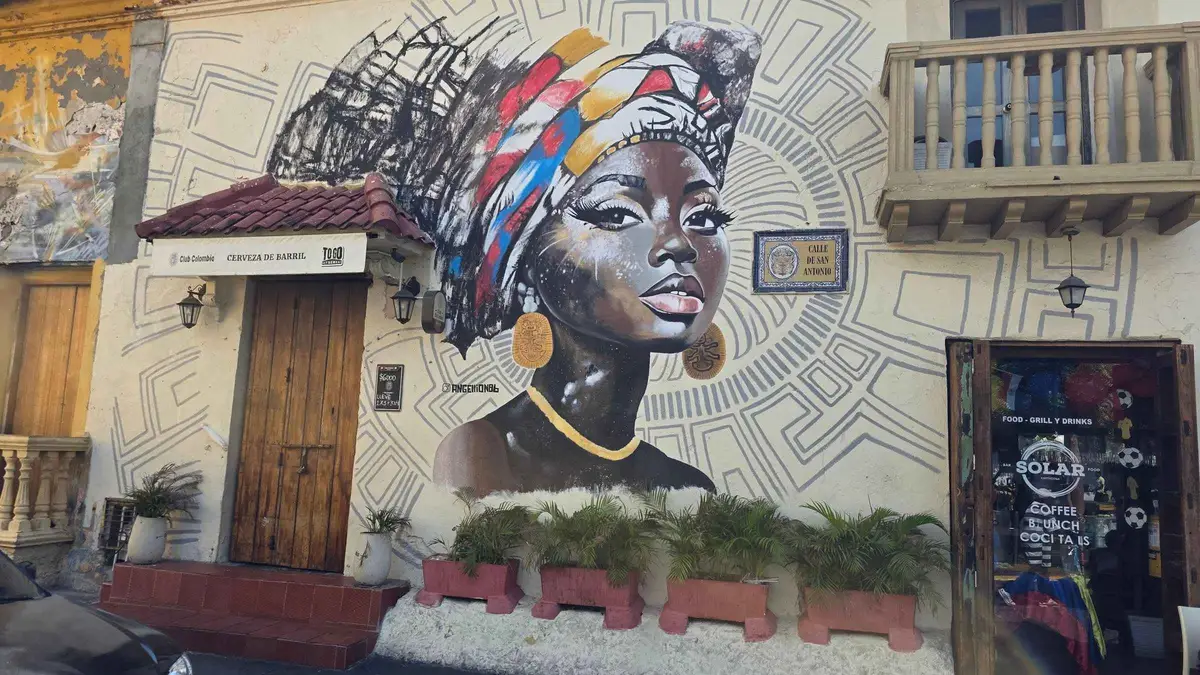
Cartagena: Walking Tour - 6 Language Options
The same Historic Center and Getsemani ground covered by most walking tours here, but with a live guide offered in six languages including French, German, Portuguese and Italian. It suits mixed-nationality groups, though reviewers say the content overlaps heavily with other walking tours if you've already done one.
Check Availability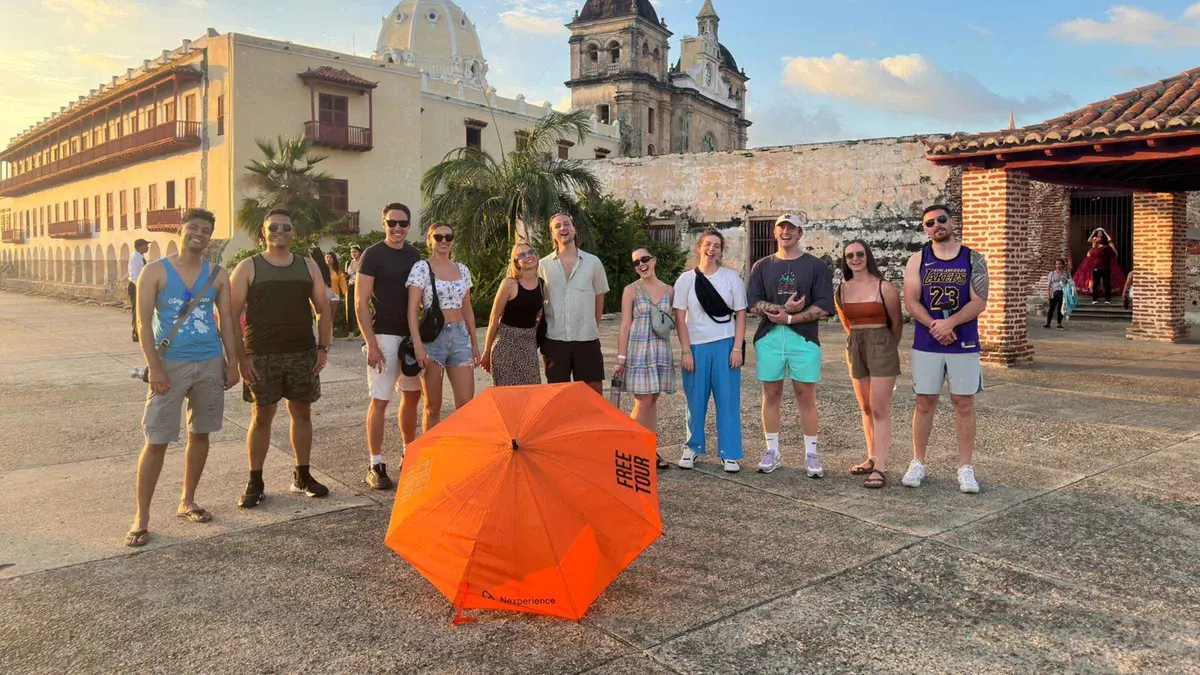 from $14.81
Cartagena: Historic Center and Getsemaní Shared Walking Tour
A shared 2.5-hour walk through the Walled City and into Getsemani, covering the slave-trade history, the Clock Tower and the plazas behind it. Groups can run large since it's a shared departure, and there's no seating or shade break built into the route.
Check AvailabilityPrices, ratings and details are the platform's own. dollar figures are the listed prices — the platform bills in your account's currency.
History: from a wooden footbridge to the Vauban school's best-kept gate
The gate standing today replaced an earlier one. In 1704 the military engineer Juan de Herrera y Sotomayor began repairing the 1631 Puerta del Puente, which had led onto a wooden bridge dating from 1540. That bridge crossed the Caño de San Anastasio, a seawater channel that once separated the walled island of Calamarí from Getsemaní [Wikipedia, Puerta del Reloj]. The work Herrera carried out between 1704 and 1738 is what gives the gate its current form, a Postclassic facade with a Roman arch flanked by Tuscan columns, a style that echoes the Monasterio de San Francisco in Santo Domingo [Wikipedia, Puerta del Reloj].
The original 1631 gate was partly destroyed by the French privateer Bernard Desjean, Baron de Pointis, during his 1697 raid on Cartagena [Wikipedia, Puerta del Reloj es]. What Herrera rebuilt afterward is considered, among specialists, one of the most successful works of the Spanish-American Fortification School and one of the best-preserved gates in the Americas, because it strictly follows the design principles of the Vauban school of fortification [Wikipedia, Torre del Reloj es].
Two names for one gate: Puerta del Reloj and Boca del Puente
Locals in Cartagena still call this gate Boca del Puente, the Mouth of the Bridge, a name that survives from the drawbridge that once stood at this spot. That drawbridge did double duty as a defense: in the event of an attack, it could be raised to block pirates and buccaneers from reaching the city, working alongside the bastions of San Pedro Apóstol and San Juan Bautista that once flanked the gate [Wikipedia, Puerta del Reloj].
The name most visitors know, Puerta del Reloj or Torre del Reloj, comes from the clock added to the top of the tower in the early 18th century. Before the clock, this was simply the city's main gate, the point where the Isla de Calamarí, the walled core of Cartagena, connected to Getsemaní across the water. Today both names point to the same structure, and either one will be understood locally.
What to actually look for when you walk through
The gate sits between two plazas that tell different parts of Cartagena's story. On the walled-city side is Plaza de la Independencia, and on the Getsemaní side is Plaza de los Coches, a triangular square that was once the city's slave market, one of the largest in the Americas during the colonial period. Today it's lined with arcaded buildings and vendors, a working plaza rather than a memorial, and the gate's arch frames the view straight through it.
Look at the facade itself for the half-point Roman arch and its two pairs of Tuscan columns, the entablature with a triglyph-decorated frieze, and the clock that gives the gate its everyday name. None of the tower's interior is open to the public, so there's no line to skip and no ticket booth to look for, unlike Cartagena's paid monuments such as Castillo San Felipe. The whole visit here is the walk-through and the look up, not an indoor tour.
The gate is also lit at night, and the facade reads differently after dark, the arch and columns picked out against the surrounding buildings, a detail worth a second look if you pass through on your way to dinner in Getsemaní. Photographers tend to shoot it either early morning, before the plazas fill with vendors and tour groups, or after sunset, when the crowd thins and the lit stonework has the frame mostly to itself.
Getting to Torre del Reloj
The gate sits at the edge of the historic center, an easy walk from almost anywhere inside the walled city and from most of Getsemaní. Most visitors pass through it more than once a day without planning to, since it's the natural route between the two neighborhoods, and several walking tours either start or pass through here as their first stop.
If you're arriving by taxi or rideshare, ask to be dropped at Plaza de los Coches or Plaza de la Independencia rather than naming the gate itself, since drivers know both plazas by name. From either plaza, Torre del Reloj is a few steps away, and the rest of the walled city opens out from there.
Torre del Reloj map: where the walled city meets Getsemaní
The gate sits exactly on the line between the historic center and Getsemaní, so most walking routes between the two pass through it.
Next stop from Torre del Reloj
Everything here is walkable, the gate sits right at the junction of the walled city and Getsemaní. Walk minutes are our estimates from GPS distances.
Cartagena Walled City
The fortified historic center the gate has opened onto since the colonial period. Free to walk, same as the gate itself.
You are standing at its main gateGetsemaní
The neighborhood on the other side of the old drawbridge, once a separate island from the walled city.
About 150 m, through the gateLas Bóvedas
The free souvenir arcade at the wall's northeastern end, a natural continuation of a walk that starts at the gate.
About 900 m along the inside of the wallTorre del Reloj questions
Is Torre del Reloj free to visit?
Yes. It is a public gate and plaza, not a ticketed monument, so there is no admission fee and no official visitor page selling one.
Can you go inside or climb the Torre del Reloj clock tower?
No. The tower's interior is not open to the public. What you can see is the facade, the arch, and the two plazas it connects, Plaza de la Independencia and Plaza de los Coches.
What is the history of Torre del Reloj?
The current gate dates to repairs carried out between 1704 and 1738 by military engineer Juan de Herrera y Sotomayor, replacing an earlier 1631 gate that had been partly destroyed during a 1697 pirate raid. It became Cartagena's main entrance and is considered one of the best-preserved gates built under the Vauban school of fortification anywhere in the Americas.
Why is Torre del Reloj also called Boca del Puente?
A drawbridge once stood at this spot, crossing the Caño de San Anastasio that separated the walled city from Getsemaní. Locals still use the older name, Boca del Puente, the Mouth of the Bridge, alongside Puerta del Reloj.
What is Plaza de los Coches, next to the gate?
It's the triangular square on the Getsemaní side of Torre del Reloj, historically one of the largest slave markets in the Americas during the colonial period. Today it is a working plaza lined with arcaded buildings and vendors.
What hours is Torre del Reloj open?
It is always accessible, since it is a public street and gate rather than a site with posted opening hours. No authority publishes a visitor schedule because there is nothing to schedule.
Prices, hours and terms are set by the venue or operator and confirmed at checkout.
We may earn a commission if you book through one of our links, at no extra cost to you. Full affiliate disclosure