 Cartagena City Guide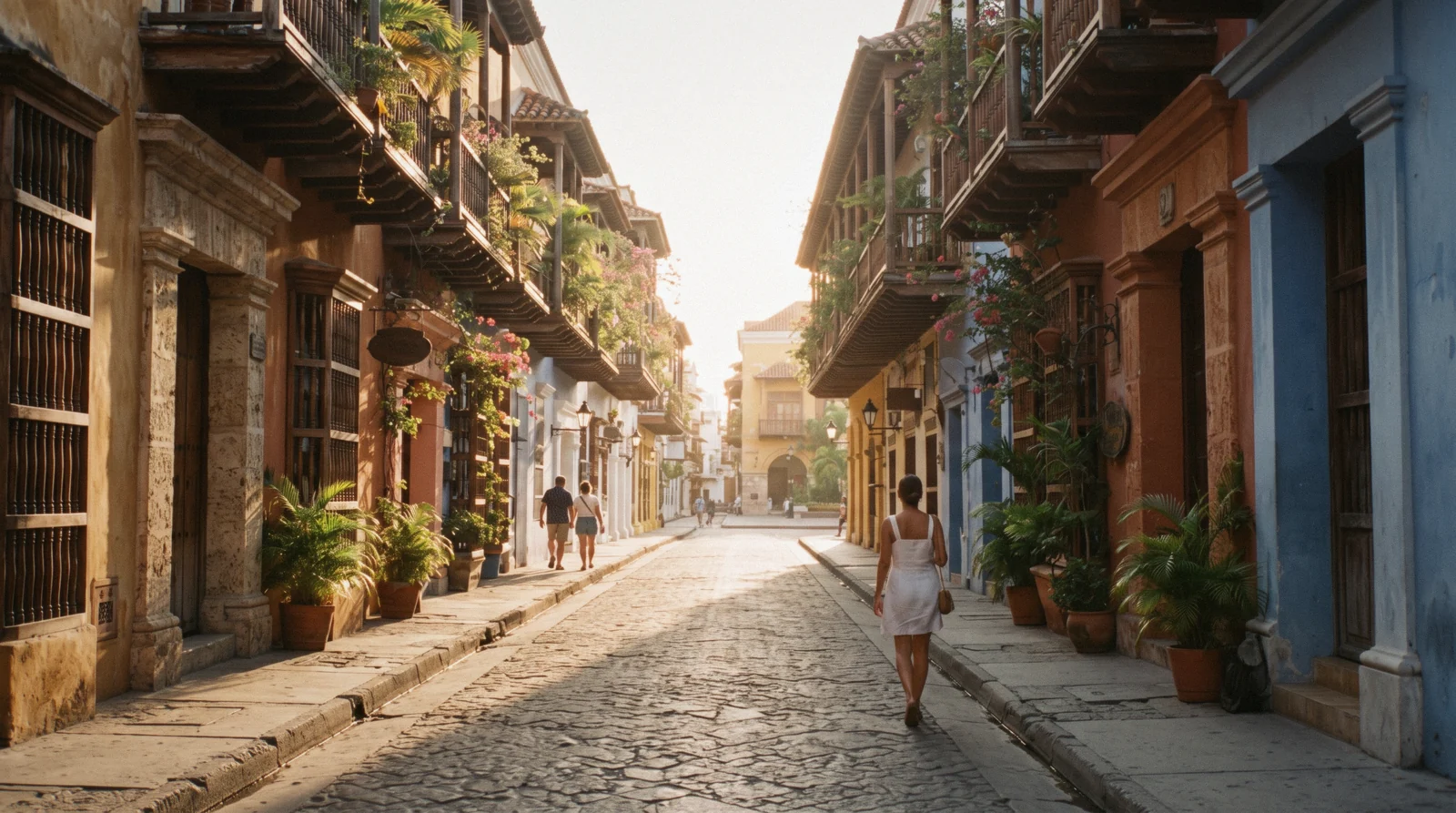
Centro Histórico, Cartagena: San Diego, El Centro and the Plazas by the Hour
The Centro Historico Cartagena visitors picture is not one neighbourhood. It is a walled peninsula split into three historic sectors, and each has its own mood. San Diego in the north is the quiet, residential one. El Centro proper is the museum and plaza core around the cathedral. And south of the walls sits Getsemaní, a separate barrio with a separate character, covered on its own page. The fortifications themselves, the gates and Las Bóvedas belong to the walled city page, so this page sticks to what happens inside them. If you are just starting to plan, our Cartagena city guide gives you the wider city first.
Quick answer What the Centro Histórico is, in three sentences
The Centro Histórico is the walled peninsula of Cartagena, split into San Diego (quieter, boutique hotels), El Centro (the plaza and museum core) and Getsemaní next door. The cheapest anchor inside the walls is free: the Museo del Oro Zenú on Plaza de Bolívar charges nothing at all.
Key takeaways
- Getsemaní is a separate barrio south of the walls and the nightlife centre of the district, so treat it as its own destination rather than a corner of the old town.
- The gates, baluartes and Las Bóvedas belong to the walled city and its gates, which covers the fortifications in detail.
- The easiest first orientation is the shared historic center and Getsemaní walking tour at $14.81, which starts from Plaza Cervantes and covers the plazas behind the clock tower.
- For hotels inside the walls, San Diego skews quieter and more boutique. Compare options on where to stay.
San Diego, El Centro and Getsemaní Compared
This is the guide's own reading of how the three sectors of the Centro Histórico actually feel on the ground, based on repeated visits to each plaza and street. It is not an official zoning map and it is not a ranking. Use it to decide where to base yourself and where to spend your evenings.
| Sector | Character | Best for | Evening feel |
|---|---|---|---|
| San Diego | The northern sector. Quieter, more residential, heavier on boutique hotels and small galleries. | A calm base, slow mornings, galleries and restored houses. | Low key. Street life fades early compared to the south. |
| El Centro (Centro proper) | The core. Plaza de los Coches, Plaza de la Aduana, Plaza de Bolívar and the cathedral, with vendors and horse carriages by day. | Museums, churches, first-visit sightseeing. | Mixed. Plazas stay active, but the museum crowds go home. |
| Getsemaní | The working-class-turned-nightlife barrio just south, separate from the walled core. | Street art, bars, nightlife, budget stays. | The loudest part of the district. See Getsemaní. |
No official price index compares dining between the sectors, so treat the real difference as one of character: San Diego and El Centro are the museum-and-plaza sector, Getsemaní is the nightlife-and-bar sector. Detail on Getsemaní lives on its own page.
Tours That Actually Walk This District
Each option below covers ground inside the Centro Histórico, and we name what each one really is. The shared walk is the budget pick, the private tour adds food tastings, the six-language tour solves a language problem, the vintage car is built around photographs rather than narration, and the cooking class takes place inside a historic-centre restaurant kitchen. Figures current in Q3 2026.
 from $14.81
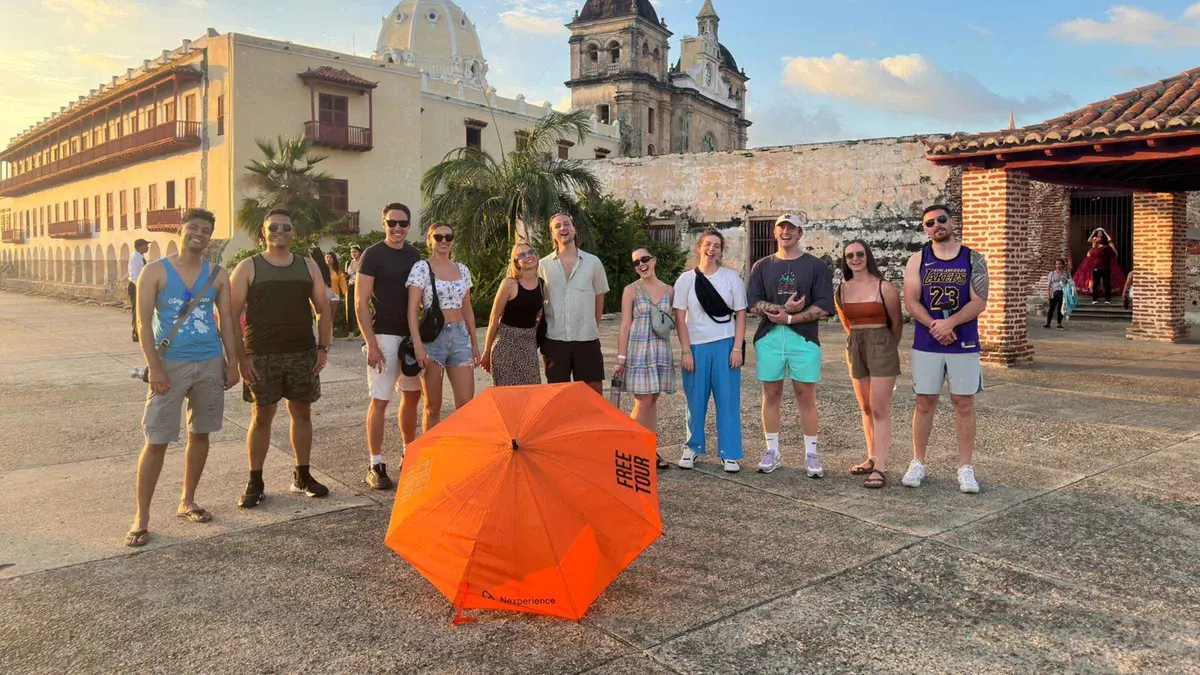
Cartagena: Historic Center and Getsemaní Shared Walking Tour
A shared 2.5-hour walk through the Walled City and into Getsemani, covering the slave-trade history, the Clock Tower and the plazas behind it. Groups can run large since it's a shared departure, and there's no seating or shade break built into the route.
Check Availability from $80.87
Cartagena: Walled City & Getsemani Private Tour
A private version of the Walled City and Getsemani route, with two Colombian snack tastings and an optional 30-minute drive out to Castillo San Felipe de Barajas at extra cost. Private pricing makes it one of the more expensive walking options here, and the castle stop isn't included in the base price.
Check Availability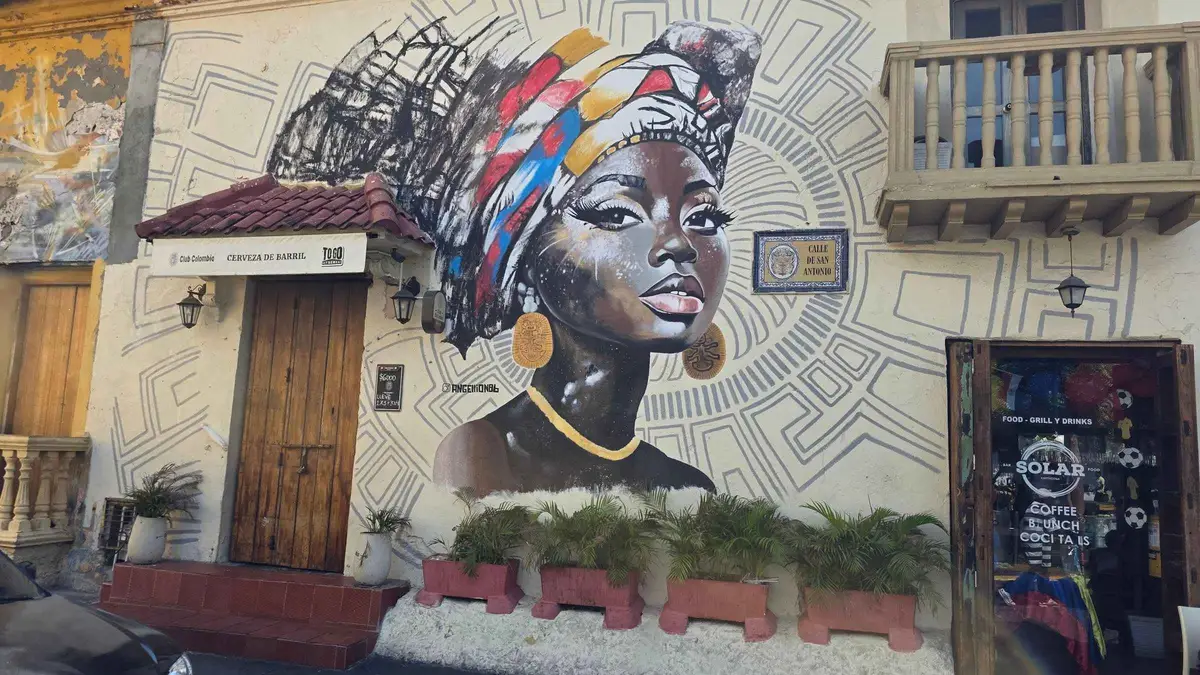 from $22.40
Cartagena: Walking Tour - 6 Language Options
The same Historic Center and Getsemani ground covered by most walking tours here, but with a live guide offered in six languages including French, German, Portuguese and Italian. It suits mixed-nationality groups, though reviewers say the content overlaps heavily with other walking tours if you've already done one.
Check Availability from $24.69
Vintage car ride with photo shoot in Cartagena das Índias
A vintage-car ride and photo shoot through the Walled City in a classic 1930s to 1950s car, ending with a styled photo session. It's built around the photos more than sightseeing narration, so it's not the tour to pick if you want a detailed history walk.
Check Availability from $40
Cartagena: Traditional cooking class in a restaurant in the historic center
A hands-on cooking class in a historic-center restaurant kitchen with two chefs, making coconut rice, red snapper and patacones from scratch, capped at 8 participants. It runs about 2 hours despite a longer stated availability window, so confirm the exact start time after booking.
Check AvailabilityPrices, ratings and details are the platform's own. dollar figures are the listed prices — the platform bills in your account's currency.
The Three Sectors, Street by Street
A short walk crosses all three sectors, but the feel changes block by block.
San Diego: the Quiet North
San Diego is the northern sector of the walled peninsula. It is the quietest of the three, more residential in character, and the part of the Centro Histórico with the heaviest concentration of boutique hotels in restored mansions. Galleries and small shops sit along the same streets.
If you want to sleep inside the walls without sleeping on top of the crowds, this is the sector to search first, and the practical comparison of areas is on where to stay. The scale of the whole district is small. As a rough estimate, not a published figure, an unhurried walker crosses from the northern edge of San Diego to the southern edge of El Centro in well under half an hour, so the sectors are best understood as moods rather than destinations requiring transport between them.
- Quietest of the three sectors, especially at night.
- Boutique hotels in restored colonial houses dominate the lodging stock here.
- Galleries and small design shops cluster on the same blocks as the hotels.
- For walls, gates and Las Bóvedas at the northern end, see the walled city page.
El Centro Proper: the Museum and Plaza Core
El Centro is the sector most people picture when they say centro historico cartagena. It holds the arrival plazas by the clock tower gate, Plaza de los Coches and Plaza de la Aduana, and the civic core around Plaza de Bolívar, the cathedral and the Palacio de la Inquisición. Vendor and horse-carriage activity concentrates here by day, and the museum cluster means daytime foot traffic peaks between late morning and mid afternoon.
This is also where most guided walks converge. The shared historic center and Getsemaní walking tour starts from Plaza Cervantes outside the walls and moves straight into this sector.
- Plaza de los Coches and Plaza de la Aduana are the arrival plazas nearest the clock tower gate.
- Plaza de Bolívar carries the two headline museums and the cathedral.
- Horse carriages and vendors operate by day in the arrival plazas.
- The private walled city and Getsemaní tour also routes through this sector.
Getsemaní: a Different Barrio Entirely
Getsemaní sits south of the walled core and has its own history as a working-class barrio, now the district's nightlife engine with street art and bars to match. Because it is a distinct neighbourhood with its own plazas and its own page, we will not restate it here. Read Getsemaní for the detail, and use the contrast simply: San Diego is where the district is quiet, El Centro is where it is civic and museological, and Getsemaní is where it is loud after dark.
The Plazas and What Each One Is For
Each plaza inside the walls has a job. Some work by day, some carry the museums, and one is a photo stop with a bronze sculpture.
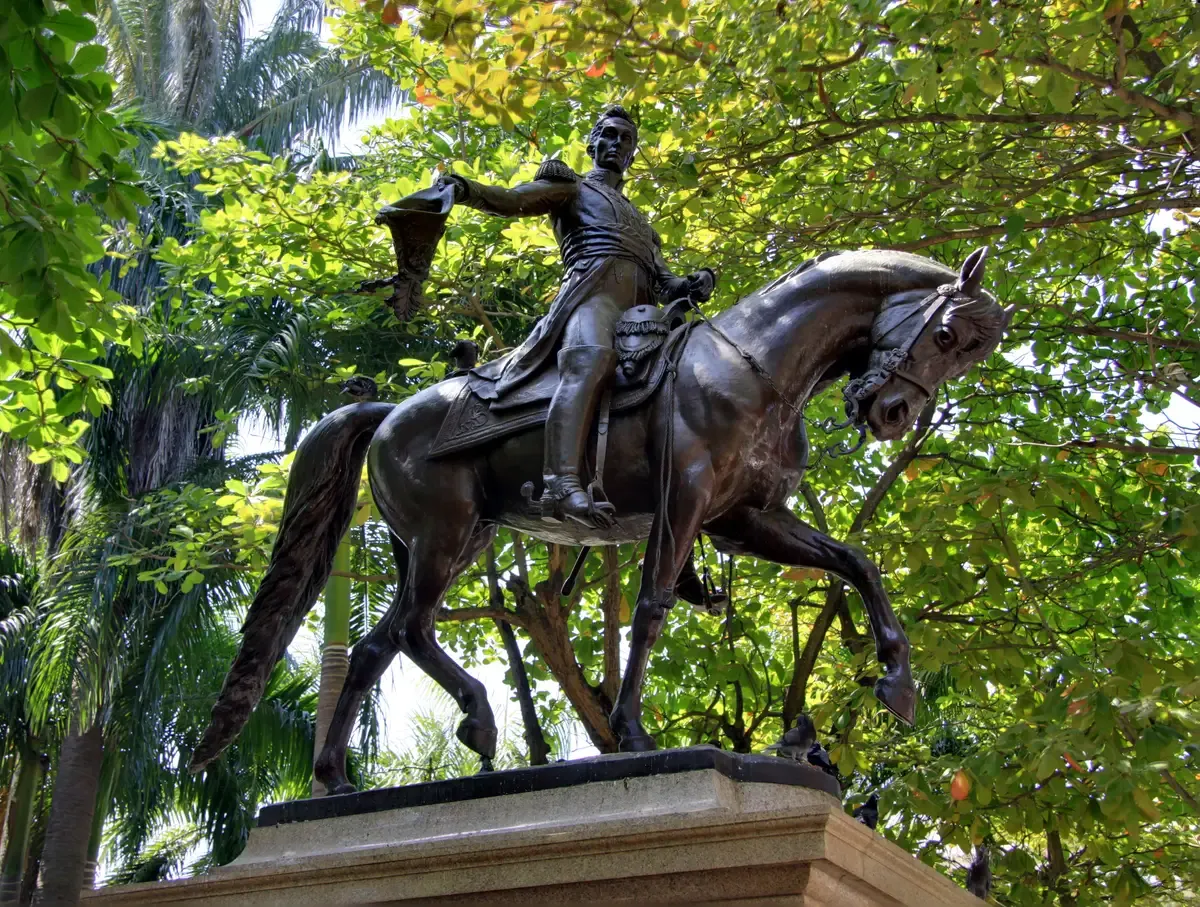
Bolívar on his plaza in the Centro Histórico. Photo: Martin St-Amant (S23678), CC BY-SA 3.0, via Wikimedia Commons
Plaza de Bolívar: the Daytime Square
Plaza de Bolívar is the civic heart. The Palacio de la Inquisición and the cathedral face onto it, and trees shade benches that fill with people waiting for museum entry. This is a square that reads as daytime.
Museum queues, shade, pigeons and school groups define it, and there is little reason to come here for nightlife. If you want the two headline museums, plan the visit around this plaza. The Museo del Oro Zenú on its edge is free, and the Palacio de la Inquisición charges $7.61 ($24,000 COP) for adults, with full details in the museums section.
Plaza de los Coches and Plaza de la Aduana: the Arrival Plazas
These two plazas sit nearest the clock tower gate, which is the main arrival point from outside the walls. Plaza de los Coches carries the vendor activity, and horse carriages line up here by day offering rides around the district. Plaza de la Aduana, just behind, is broader and anchored by colonial facades.
Both are at their most active in the morning and through the middle of the day, when arrivals, vendors and carriage traffic overlap. The clock tower gate itself, and the other gates of the city, are covered on the walled city page, which owns the fortification detail.
Plaza de Santo Domingo: the Botero and the Oldest Church
Plaza de Santo Domingo is anchored by the Iglesia de Santo Domingo, the city's oldest church, founded in 1551, with Botero's bronze sculpture Mujer Reclinada on the plaza outside. It works as a linger-and-photograph square. No confirmed official hours or price could be found for entry to the church, and no schedule could be confirmed from an official source, so treat any mass time printed on an aggregator as unverified.
See the churches section for what is and is not confirmed.
Plaza San Pedro Claver: the Sanctuary and the Modern Art Museum
Plaza San Pedro Claver carries two paid sites side by side: the Iglesia y Santuario de San Pedro Claver, at Carrera 4 No. 30-01, and the Museo de Arte Moderno de Cartagena (MAMC) at Calle 30 No. 4-08. The sanctuary opens weekdays 9:00 a.m.-4:30 p.m. and weekends and holidays 10:00 a.m.-4:00 p.m., so plan the plaza for the first part of the day. The MAMC stops admitting visitors within the last hour of its 11:00 a.m. to 5:00 p.m. window, making 4:00 p.m. the effective cutoff.
Both sites' full price grids, including the Bolívar-resident discount at San Pedro Claver, are in the museums section.
The Museums Inside the Walls, and What Each One Actually Costs
Five sites do the heavy lifting inside the walls. Prices below come from each museum's own published page (muhca.gov.co, museonavaldelcaribe.org, mamcartagena.org and sanpedroclaver.co), not from aggregators, and the common mistakes are easy ones: turning up at the free gold museum on a Monday, or arriving at the modern art museum after its 4:00 p.m. admission cutoff. The Naval museum sits at Calle San Juan de Dios No. 3-62 on Plaza Santa Teresa, a short step from the arrival plazas. The Museo del Oro Zenú and the Palacio de la Inquisición share Plaza de Bolívar, which makes that square the natural single stop for two very different visits. Note the deliberate split in the MAMC's pricing between foreign and Colombian visitors, and the same split at San Pedro Claver.
Two practical notes. First, the Museo del Oro Zenú is free because the Banco de la República gold museum network is free nationwide, and its Monday closure is the single most common scheduling error in the district. Second, older blog figures still circulate for the Palacio de la Inquisición and the Naval museum, and both official grids have since changed, so trust the numbers above over anything quoted on a travel blog.
| Site | Adult (foreign) | Hours | Closed |
|---|---|---|---|
| Palacio de la Inquisición (MUHCA) | $7.61 ($24,000 COP), concessions $6.35 ($20,000 COP), under 5 free | Mon-Sat 9:00 a.m.-6:00 p.m., Sun and holidays 10:00 a.m.-4:00 p.m. | Not stated |
| Museo del Oro Zenú | Free | Tue-Sat 9:00 a.m.-5:00 p.m., Sun 10:00 a.m.-3:00 p.m. | Monday |
| Museo Naval del Caribe | $7.61 ($24,000 COP), student $3.17 ($10,000 COP), child and military $1.59 ($5,000 COP), group of 4-5 $25.40 ($80,000 COP) total | Regular days 10:00 a.m.-6:00 p.m., vacation periods 9:00 a.m.-6:00 p.m. | Not stated |
| Museo de Arte Moderno de Cartagena (MAMC) | $8.25 ($26,000 COP), concessions (under 10, 60+, students) $5.08 ($16,000 COP), Colombian adults $6.66 ($21,000 COP) | 11:00 a.m.-5:00 p.m., no entry in the last hour | A weekday and weekend split with a Monday closure appears in one unofficial snippet only, unconfirmed |
| Iglesia y Santuario de San Pedro Claver | $9.52 ($30,000 COP), concessions $6.98 ($22,000 COP), Colombian adult $6.66 ($21,000 COP), Bolívar resident adult $2.54 ($8,000 COP), under 6 free | Weekdays 9:00 a.m.-4:30 p.m., weekends and holidays 10:00 a.m.-4:00 p.m. | Not stated |
The Churches: What Is Confirmed and What Is Not
Two churches anchor the visitor's mental map of the district, and for both, the honest answer is that official schedules could not be confirmed in this research pass.
Iglesia de Santo Domingo
The Iglesia de Santo Domingo on Plaza de Santo Domingo is the city's oldest church, founded in 1551, and Botero's bronze Mujer Reclinada sits on the plaza outside it. What could not be confirmed: no official hours or admission price were found in this research pass. It functions as an active parish, and entry is commonly free or by donation in practice, but no official schedule could be confirmed, so do not plan a timed visit around mass times taken from unofficial aggregators.
Come for the plaza and the sculpture, and treat the church interior as a walk-in if the doors are open.
Catedral de Santa Catalina de Alejandría
The cathedral on Plaza de Bolívar, at Calle de los Santos de Piedra and Carrera 4, is the most photographed facade in the district, and the least documented. No official hours or price were found in this research pass. No diocesan page could be confirmed, partly because the diocese domain appears to be under maintenance and shows a domain naming collision with a Spanish diocese.
Two practical facts hold. Modest dress is expected in an active place of worship. And a Mass or private ceremony can interrupt a visit without notice, so if the cathedral matters to your day, build slack around it rather than fixing it to a timetable.
Gates, Parking and How You Actually Arrive
Most visitors arrive on foot through the clock tower gate, by taxi, or on Transcaribe. Each comes with a catch worth knowing before you go.
Taxis: a Fixed-Fare Card City, With a Live Fare Conflict
Taxis in Cartagena run on a fixed-fare card system, not meters. The city is the only Colombian city over 1 million people without taxímetros, so ask to see the fare card rather than negotiating from nothing. There is an open conflict in the 2026 fare figures that we will not resolve for you, set out in the table below.
The fuller table, with airport zone fares, lives on Getting Around.
| Reading | Minimum fare | Night surcharge (7pm-5am) | Source |
|---|---|---|---|
| Decreto 0051 (press reading) | $3.89 ($12,250 COP) | $0.35 ($1,100 COP) | eluniversal.com.co, cartagena.alerta.com.co |
| City government snippet | $3.11 ($9,800 COP) | $0.29 ($900 COP) | cartagena.gov.co headline (primary decree page returned an access error, year unconfirmed) |
Transcaribe and the Bus Option
Transcaribe, the city's bus rapid transit system, charges a single fare of $1.24 ($3,900 COP), effective 23 January 2026. It is the cheapest mechanised way to reach the edges of the walled district, though you will still walk the final stretch into the pedestrian core. A registered differential fare gives a $0.32 ($1,000 COP) discount to students, older adults and Sisbén A/B users under a decree of 19 May 2026, which matters to residents more than visitors.
- Single Transcaribe fare: $1.24 ($3,900 COP).
- Taxis use fixed-fare cards, never meters.
- Night taxi surcharge window: 7:00 p.m.-5:00 a.m., per the press reading of Decreto 0051.
- Full fares and routes: Getting Around.
Parking: the Honest Answer Is That No Official List Exists
If you are driving, here is the plain finding. No official parking-lot list or price table for cars entering or near the Centro Histórico was found in this research pass. We will not name a lot or quote a rate we cannot source.
In practice, the streets inside the walls are narrow, much of the core is pedestrian-priority, and most visitors who stay inside the district arrive by taxi or on foot and simply do not need a car. If a hotel search matters more than a parking search, start at where to stay and ask your lodging directly about vehicle arrangements.
Centro by Day, Getsemaní by Night: the Honest Difference
The real divide in this district is not a price divide. It is a clock divide.
What the Day Belongs To
Daytime inside the walls belongs to El Centro and San Diego. The museum-and-plaza sector runs on the hours printed in the museums section: the gold museum free and closed Mondays, the Inquisición palace from 9:00 a.m., the modern art museum cutting admissions at 4:00 p.m. Vendors and horse carriages work the arrival plazas, Plaza de Bolívar fills with benches and shade, and San Diego stays calm enough to read as residential.
No official price index compares dining between the sectors, so any claim that one sector eats cheaper than the other would be invented. What actually differs is what each sector is for, and that is the comparison that matters when you plan a day.
What the Night Belongs To
After dark the centre of gravity moves south. Getsemaní is the nightlife-and-bar sector of the district, and El Centro's plazas stay pleasant for an evening walk without turning into a bar crawl. If a loud night is the goal, point it at Getsemaní.
If a quiet night is the goal, sleeping in San Diego and eating nearby is the structure that delivers it, and the hotel comparison is on staying here. One honest warning applies everywhere in the district after dark: read safety and scams before your first night out.
Near the Centro Histórico
Three pages cover the ground that touches this district directly.
Getsemaní
The nightlife and street-art barrio on the other side of the centre. It has its own plazas, its own rhythm and its own page, so Getsemaní is where its detail lives.
Adjacent barrio, just south of the walled coreThe Walled City Walls and Gates
The fortifications, the gates including the clock tower gate, and Las Bóvedas are all covered on the walled city page. This page deliberately leaves the walls to it.
Forms the boundary of the district itselfCastillo San Felipe de Barajas
The great fortress is not inside the Centro Histórico, but it is the single biggest sight most visitors pair with it. Full admission and visiting detail is on Castillo San Felipe.
Outside the walls, a short ride from the centreCentro Histórico Questions
Is the Centro Histórico the same thing as the Walled City?
Almost, but not quite. The Centro Histórico is the walled peninsula and its three historic sectors, San Diego, El Centro and Getsemaní. The fortification walls themselves, the gates and Las Bóvedas are covered separately on the walled city page.
Which sector of the Centro Histórico should I stay in?
San Diego if you want quiet and boutique hotels, El Centro if you want to step straight out to the plazas and museums. The sector-by-sector comparison is on where to stay.
How much do the museums inside the walls cost?
The headline figures are free at the Museo del Oro Zenú, $7.61 ($24,000 COP) at the Palacio de la Inquisición and the Museo Naval del Caribe, and $8.25 ($26,000 COP) at MAMC for foreign adults. The full grid with hours is in the museums section.
Can I visit the cathedral and Santo Domingo any time?
No official hours or prices could be confirmed for either church in this research pass, and a Mass or private ceremony can interrupt a cathedral visit without notice. What is confirmed about each is in the churches section.
Do I need a tour to see the Centro Histórico?
No, every plaza and street here is walkable on your own, but a first-day orientation helps. The shared historic center and Getsemaní walking tour at $14.81 covers the plazas behind the clock tower, and the six-language walking tour exists if you need French, German, Portuguese or Italian.
How do I get to the Centro Histórico from the airport or Bocagrande?
By taxi on the fixed-fare card system, since Cartagena has no taxímetros, though the 2026 minimum fare sits in an unresolved conflict between $3.89 ($12,250 COP) and $3.11 ($9,800 COP). Transcaribe charges $1.24 ($3,900 COP) single. The full table is on Getting Around.
Where should I go at night, El Centro or somewhere else?
For nightlife, the answer is next door. Getsemaní is the district's bar and street-art barrio, while El Centro's plazas stay calm in the evening. Read Getsemaní for the full picture, and check safety and scams before your first night out.
Is 'casco histórico' the same as 'centro histórico', and what should I visit in the 'zona centro'?
Yes. Casco histórico and centro histórico both name the same walled district, and zona centro usually points at El Centro, the plaza and museum sector covered in the sectors section. What to visit, qué visitar, comes down to the plazas and the five museums in the museums section. If you ask a local for la calle más famosa, the most famous street, most point toward the streets around Plaza de la Aduana and the clock tower gate, though the city publishes no official ranking of one street over another.
Prices, hours and terms are set by the venue or operator and confirmed at checkout.
We may earn a commission if you book through one of our links, at no extra cost to you. Full affiliate disclosure